The Domino Effect: How a U.S. Attack on Iran Could Unleash Global Catastrophe
02/20/2026 / By Mike Adams
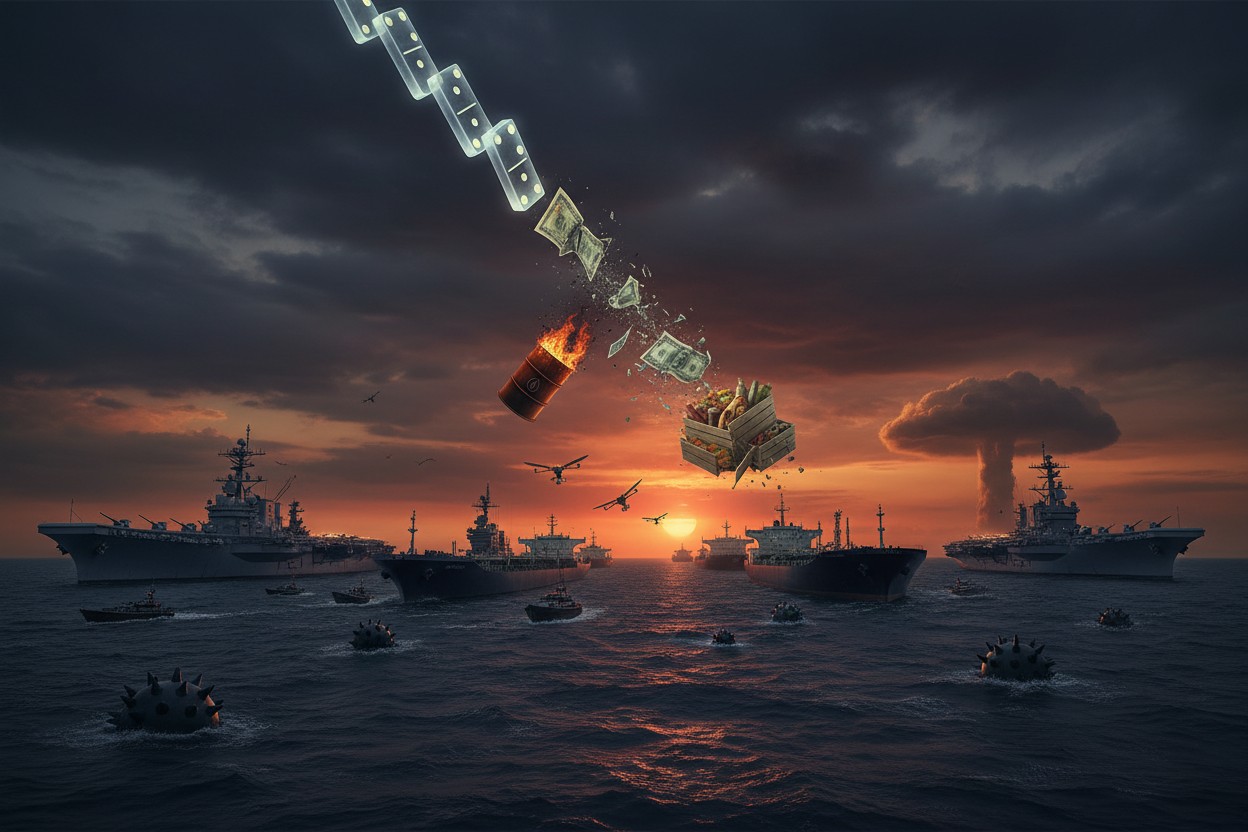
The Strait of Hormuz as a Global Tinderbox
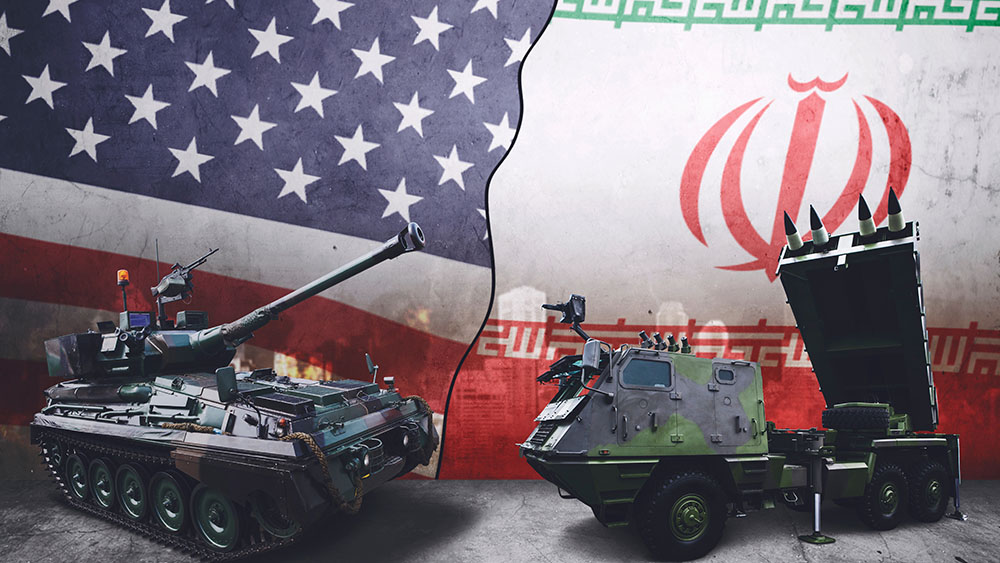
The Persian Gulf is a powder keg, and the United States under President Donald Trump is striking the match. In February 2026, the U.S. has massed an unprecedented level of naval firepower in the region, with the USS Abraham Lincoln carrier strike group already stationed there and the USS Gerald R. Ford diverted from the Caribbean to join it [1]. This mobilization follows President Trump’s blunt ultimatum to Iran demanding ‘unconditional surrender’ or facing the full might of U.S. military power [2]. The world holds its breath as the mechanisms of war shift into high gear.
At the heart of this peril is a 30-mile-wide artery of global commerce: the Strait of Hormuz. This chokepoint carries an estimated 20 million barrels of oil daily, representing over 20% of global supply [3]. Analysts warn that any U.S. attack would almost certainly trigger Iran’s promised retaliation, likely beginning with the mining of this strait or the deployment of fast-attack boats and drones to disrupt or destroy oil tankers [4]. The immediate effect would be an overnight energy shock of historic proportions. Gasoline prices would skyrocket to $12 or more per gallon, triggering instantaneous hyperinflation in transportation and logistics costs worldwide [3]. This event is not a mere regional conflict; it is the ‘black swan’ that would trigger cascading failures across finance, geopolitics, and global supply chains, plunging the world into a crisis from which it may not recover.
Financial and Monetary Collapse: The Dollar’s Demise
The closure of the Strait of Hormuz would send oil prices soaring to a predicted $150-$300 per barrel [5]. This hyperinflation in the foundational cost of energy would instantly cripple consumer economies. The cost of everything from food production to home heating would explode, devastating household budgets and shattering business models reliant on affordable fuel. The petrodollar system, already under immense strain, would face its death blow. This system, established in the 1970s, relies on U.S. military power to enforce oil transactions in dollars [6]. A failed military adventure in Iran would shatter the illusion of American omnipotence that underpins this financial architecture.
As confidence in U.S. military guarantees evaporates, nations would rapidly seek alternatives. The U.S. Dollar Index (DXY) has already collapsed more than 10% in twelve months, a flashing red alert for systemic failure [7]. A Hormuz crisis would accelerate this collapse into a freefall. Treasury yields would spike as faith in U.S. debt evaporates, triggering a liquidity crisis across the global banking system. Stock markets would correct by 30-50% as the reality of a broken global economy sets in. Crucially, this moment would provide the perfect catalyst for a coordinated announcement from the BRICS nations, particularly China, of a gold-backed trading currency to replace the dollar [8]. Such a move would formally end dollar hegemony, instantly rendering trillions in U.S. debt and currency holdings nearly worthless abroad and triggering hyperinflation at home.
Geopolitical Realignment and Global Supply Chain Devastation
The geopolitical dominoes would fall swiftly. Nations across the Middle East and beyond, witnessing American overreach and impotence, would pivot away from Washington’s orbit. The Gulf states, despite historical tensions with Tehran, would be forced to reckon with a new regional power dynamic shaped by a humiliated United States. As noted by geopolitical analyst Pepe Escobar, the American ‘Empire of Chaos’ is striking in a panic of ‘being evicted from Eurasia’ [9]. An attack on Iran would formalize that eviction, with BRICS nations—Russia, China, India, Brazil, and South Africa—gaining immense influence as the architects of a new, non-dollar financial order.
The practical consequences for global trade would be catastrophic. Maritime insurance premiums for vessels transiting the Middle East would become prohibitively expensive overnight. Shipping companies would be forced to reroute all traffic around the Cape of Good Hope in Africa, adding weeks to delivery times and billions in additional fuel costs. Global supply chains, already fragile, would snap. European industrial powers like Germany, reliant on stable energy imports, would face immediate and severe manufacturing declines, leading to mass layoffs and social unrest. China, the world’s factory, would see its export engine grind to a halt as raw material imports dry up and finished goods cannot be shipped profitably. The world would fracture into hostile trading blocs almost overnight.
Social Unrest, Political Fallout, and Escalating Conflict
The economic shockwave would translate directly into human misery and political chaos. Within the United States, mass unemployment from shuttered industries would overwhelm social welfare systems designed for routine recessions, not total economic collapse. Civil unrest would become inevitable as shelves empty and law enforcement breaks down. The political destruction would be swift and severe. The Republican Party, which currently holds majorities in Congress, would be annihilated for presiding over such a self-inflicted disaster. Public anger would mount so fiercely that, as some analysts warn, it could even lead to an attempted military coup against President Trump as the only perceived way to stop the bleeding and restore order [5].
Regionally, the conflict would not be contained. Iran has vowed that another U.S.-Israeli attack would be an ‘existential war,’ and it would respond in a way that ‘eliminates any incentive for restraint,’ unleashing a conflict ‘that would be impossible to control’ [10]. This would likely involve coordinated strikes by Iranian proxies—Hezbollah in Lebanon, the Houthis in Yemen, and Shia militias in Iraq—against U.S. bases and Israeli territory. Nations like Turkey and Egypt would be drawn into the fray, and the risk of a nuclear exchange would become terrifyingly real. As Russia’s ambassador to Iran warned, the world is ‘millimeters’ away from a nuclear catastrophe [11]. Pakistan or a cornered Israel could feel compelled to use their nuclear arsenals, setting the stage for a regional—and potentially global—holocaust.
Infrastructure and Technology Sector Implosion
The collapse would penetrate the very backbone of modern civilization: energy, materials, and food. A prolonged Strait of Hormuz closure would create a global Liquefied Natural Gas (LNG) shortage. Europe, already energy-vulnerable, would face rolling blackouts that would cripple industry and freeze populations in winter. These blackouts would have a cascading effect, disrupting the massive data centers powering the global AI race and halting semiconductor production in Taiwan, South Korea, and the United States. The much-vaunted ‘AI revolution’ championed by the Trump administration would hit a brick wall, as the U.S. power grid, already at capacity, would have no surplus energy to dedicate to these power-hungry facilities [12].
Critical industrial materials would become unobtainium. The prices of aluminum and steel, essential for construction and manufacturing, would become prohibitively expensive, halting global infrastructure projects and paralyzing auto production. Most devastatingly, the global food supply chain would break down. Modern agriculture is entirely dependent on diesel fuel for tractors and transport, and on natural gas for fertilizer production. A hyperinflationary spike in these inputs would make food production economically unviable overnight. Shipping disruptions would prevent the distribution of remaining stocks. Famine would become a real threat in import-dependent nations, and even food-secure countries would face severe shortages and riots. The convergence of energy, industrial, and agricultural collapse would represent a systemic failure unseen in modern history.
The Path Away from Catastrophe
The interconnected threads of this potential disaster—financial, social, geopolitical, and technological—form a noose tightening around the neck of global stability. A U.S. attack on Iran is not a surgical strike; it is the trigger for a sequence of cascading failures that would unravel the post-World War II order. The legacy of President Donald Trump, who declared his ‘proudest legacy will be that of a peacemaker,’ now hangs in the balance [13]. To choose war is to choose economic ruin, social chaos, and the potential for nuclear escalation.
The path away from catastrophe requires a stark repudiation of the foreign policy adventurism orchestrated by neoconservative and foreign interests. As former Trump aide Steve Bannon warned, U.S. policy must prioritize ‘America First’ and avoid entanglement in conflicts like Israel versus Iran that do not serve American interests [14]. The immediate imperative is de-escalation: reviving diplomatic channels, heeding the warnings of military experts like Lt. Col. Daniel Davis about the ‘hollow Goliath’ nature of U.S. readiness [15], and prioritizing domestic stability over foreign military gambits.
The American people must demand that their representatives, like Rep. Ro Khanna and Rep. Thomas Massie who are forcing a War Powers Resolution vote, assert Congressional authority to prevent an unauthorized march to war [16]. The fate of hundreds of millions hangs on the choice between peace and a self-destructive conflict that benefits no one but the architects of chaos.
References
- A Trap in the Gulf: Why Trump’s Naval Buildup Near Iran Could End in Catastrophe – NaturalNews.com. February 17, 2026.
- Trump issues ultimatum to Iran: Surrender or face full military force – NaturalNews.com. January 6, 2026.
- Strait of Hormuz: How 30 Miles Could Quadruple Oil and Gas Prices – NaturalNews.com. Willow Tohi. July 24, 2025.
- What a U.S. Attack on Iran Could Unleash According to Experts and … – MSN.
- Oil Shock to Dollar Collapse: The Catastrophic Global Consequences of a U.S. Attack on Iran – NaturalNews.com. January 24, 2026.
- Alexander Macris on the Health Ranger Report: The Petrodollar’s Imminent Collapse and the Path to WWIII – NaturalNews.com. Kevin Hughes. April 01, 2025.
- The Perfect Storm: Dollar Collapse, Silver Shock, and Trump’s Final Gamble with Iran – NaturalNews.com. January 27, 2026.
- Mike Adams interview with Andy Schectman – April 19 2024.
- Escobar: Empire Of Chaos, Plunder, & Strikes In Panic Of Being Evicted From Eurasia – ZeroHedge.com. Pepe Escobar. January 21, 2026.
- For Iran, another US–Israeli attack would be an “existential war” – Middle East Eye. Seyed Hossein Mousavian. January 27, 2026.
- Russia Warns World Is ‘Millimeters’ Away From Nuclear Catastrophe – Time.
- Why Trump’s War on Iran Would Shatter U.S. Military Readiness and Trigger Global Collapse – NaturalNews.com. January 30, 2026.
- Trump Should Revive the JCPOA To Prevent War With Iran – Antiwar.com. JD Hester. February 11, 2026.
- Bannon Warns Against “Israel First” in U.S. Policy as Trump Champions Pro-Israel Stance – NaturalNews.com. Willow Tohi. June 17, 2025.
- The Hollow Goliath: Why the U.S. Military May Be a Paper Tiger Facing Catastrophic Defeat – NaturalNews.com. February 18, 2026.
- Rep. Khanna To Force Vote On Iran War Powers: ‘Another Endless Dumb Foreign War’ – ZeroHedge.com. Dave DeCamp. February 19, 2026.
- Netanyahu, the ultra-Zionists and Death Cult didn’t want a peaceful agreement between the West and Iran because it’s on their list for regime change. He and his fellow crazies are obsessed with regime-change in Iran.
- A tight-knit group of Pentagon officials and defense experts outside government is working to mobilize support for a military operation to oust President Saddam Hussein of Iraq as the next phase of the war against terrorism.
Submit a correction >>
Tagged Under:
big government, bubble, chaos, Collapse, Dangerous, debt collapse, dollar demise, Donald Trump, economic riot, finance riot, Iran, market crash, Middle East, money supply, national security, risk, supply chain, US, violence, White House, World War III
This article may contain statements that reflect the opinion of the author
RECENT NEWS & ARTICLES