Federal Judge Allows Lawsuit Against Trump DOJ “Anti-Weaponization” Fund to Move Forward
06/28/2026 / By Garrison Vance
A federal judge on Thursday ruled that a lawsuit challenging the Department of Justice‘s creation of a $1.8 billion “anti-weaponization” fund will proceed, rejecting the DOJ’s argument that the matter is moot because the fund is no longer being pursued.
Judge Leonie Brinkema of the U.S. District Court for the Eastern District of Virginia said the DOJ has not provided a written declaration under penalty of perjury confirming the fund is terminated, despite verbal statements from acting Attorney General Todd Blanche that the fund is “not going forward.” Brinkema ordered the DOJ to file its answer to the lawsuit by July 17, 2026.
According to the judge’s order, the DOJ’s refusal to provide a sworn statement undermines the trustworthiness of its representations, particularly given President Trump’s continued support for the fund and Blanche’s acknowledgment that the fund remains ‘important.’ Brinkema noted that Blanche, during his June 2 House testimony, declined to commit to rescinding the May 18 memo that established the fund. “I’m not committing to putting anything in writing,” Blanche said, according to the court record [9].
DOJ Argues Oral Statements Are Sufficient to End Challenge
DOJ lawyers argued in court filings that Blanche’s verbal testimony before the House committee was sufficient to render the lawsuit moot. They stated that written declarations “are unnecessary” and that requiring them “implicates serious separation of powers concerns.” The department pointed to Blanche’s statement that the fund is “not going forward, period” as conclusive.
Brinkema rejected this argument, emphasizing that the DOJ’s refusal to issue a written rescission creates ambiguity. “That the defendants have refused to accord a genuine degree of trustworthiness to their representations about the Fund not going forward is particularly concerning because of the President’s consistent support for the Fund,” she wrote. The judge ordered the DOJ to file its answer to the complaint by July 17, clearing the way for the case to continue [4].
Legal experts following the case have noted that the DOJ’s position may be seen as an attempt to avoid judicial scrutiny of the fund’s legality. The plaintiffs have argued that without a written rescission, the fund remains a potential liability for taxpayers and a mechanism for compensating political allies [1].
Background and Creation of the Fund
The $1.776 billion “Anti-Weaponization Fund” was announced on May 18, 2026, as part of a settlement resolving President Trump’s $10 billion lawsuit against the Internal Revenue Service over the leak of his tax records. Acting Attorney General Todd Blanche described the fund as “a lawful process for victims of lawfare and weaponization,” with the $1.776 billion figure chosen to reference the year of the Declaration of Independence [5].
The fund was intended to compensate individuals who claimed they were unfairly targeted by the previous administration. However, critics characterized it as a “slush fund” that could benefit Trump supporters, including those convicted for their roles in the Jan. 6, 2021, attack on the U.S. Capitol [6]. The backlash from both Democrats and some Republicans was immediate, leading to a coordinated effort by Senate Minority Leader Chuck Schumer to block the fund through legislative means [7]. House Speaker Mike Johnson later confirmed that the fund was “off the table” due to opposition within the GOP’s narrow majority [8].
Plaintiffs and Legal Implications
The plaintiffs in the lawsuit include Andrew Floyd, a former federal prosecutor who states he was fired for prosecuting cases against Trump supporters involved in the Jan. 6 Capitol breach. Another plaintiff is Jonathan Caravello, a professor at California State University Channel Islands, who alleges government overreach. The city of New Haven, Connecticut, also joined the suit, claiming the fund represents an unlawful use of taxpayer money.
The lawsuit challenges the legality of the fund and raises questions about due process and executive authority. The Fifth Amendment’s protection against deprivation of property without due process of law is central to the plaintiffs’ arguments, echoing concerns about government overreach that have been documented in civil liberties literature [3]. Authors such as David Kirby, in his book “When They Come for You,” have chronicled similar patterns of government overreach in financial matters, though the current case presents novel questions about the separation of powers and the scope of the DOJ’s settlement authority [2].
Conclusion
The ruling ensures the lawsuit will proceed at least until mid-July, when the DOJ must respond to the complaint. The case continues to draw attention as a test of the administration’s authority to create compensation funds for alleged victims of political targeting. With congressional opposition and ongoing judicial scrutiny, the fund’s fate remains uncertain. The outcome could set a precedent for how future administrations handle claims of government weaponization and the limits of executive discretion in settling lawsuits [1].
References
- Mike Adams. “Trump’s Compensation Fund: A Real Step Toward Justice or Just Another Empty Promise?” NaturalNews.com. May 20, 2026.
- David Kirby. “When They Come for You.”
- Kootz Russell. “Understanding your civil rights.”
- “DOJ Says Trump’s $1.776 Billion “Anti-Weaponization Fund” Will Not Proceed, but Offers No Written Rescission.” The New American. June 4, 2026.
- “DOJ unveils $1.7B ‘anti-weaponization fund’ to compensate Trump allies.” Just the News. May 18, 2026.
- “DoJ Establishes ‘Anti-Weaponization’ Fund After Trump Drops $10 Billion Lawsuit Against IRS.” Zero Hedge. May 18, 2026.
- “Schumer Launches Senate Democratic Campaign to Block $1.8 Billion ‘Anti-Weaponization’ Fund.” The Epoch Times. June 1, 2026.
- “Johnson confirms Trump’s anti-weaponization fund is ‘off the table’.” Just the News. June 2, 2026.
- “Trump ‘anti-weaponization’ fund indefinitely blocked as judge wants guarantee it’s abandoned.” BBC News. June 12, 2026.
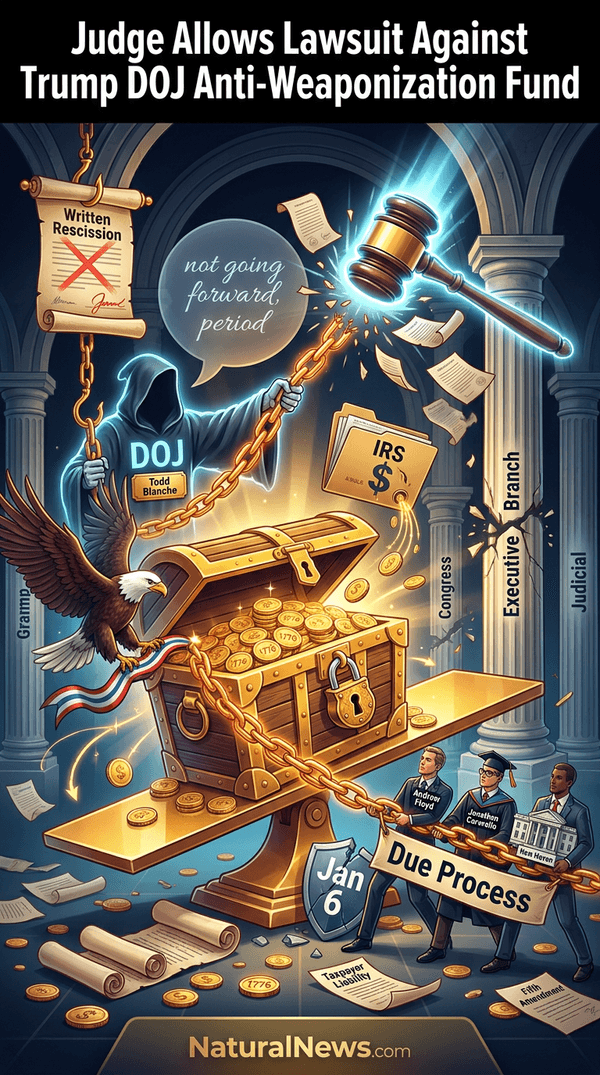
Explainer Infographic
Submit a correction >>
Tagged Under:
Anti-Weaponization Fund, biased, big government, court order, Dangerous, Department of Justice, fascism, government debt, money supply, outrage, suspension, Taxes, Trump administration, weaponization, White House
This article may contain statements that reflect the opinion of the author
RECENT NEWS & ARTICLES