Poll: Half of Americans Fear Broader Instability From Middle East War
08/08/2026 / By Garrison Vance

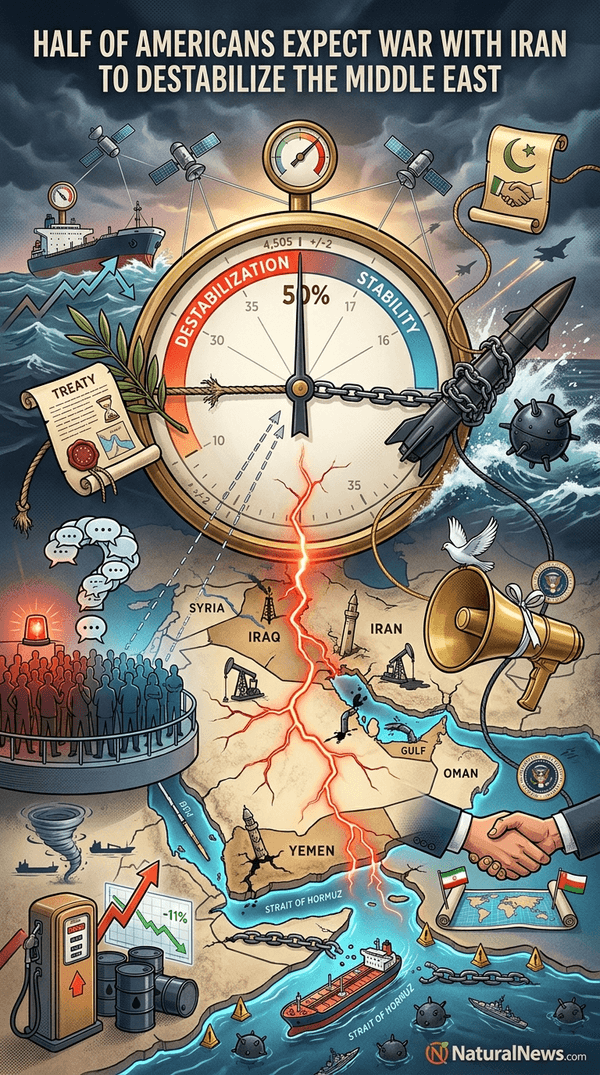
Half of U.S. adults believe a conflict between the United States and Iran would lead to serious destabilization in the Middle East over the next year, according to a Reuters/Ipsos poll released Thursday [1]. The survey, conducted jointly by Reuters and Ipsos, found that 50 percent of respondents expected serious destabilization. The six-day poll was conducted through Aug. 3 among 4,505 U.S. adults and has a margin of error of plus or minus two percentage points.
The results were published one day after President Donald Trump said he still wanted to reach a peace deal with Tehran, according to the report. The findings follow an earlier Reuters/Ipsos survey released July 27 that found roughly one in three Americans supported the war [2].
Stability Expectations and Approval of the Conflict
According to the poll, 17 percent of respondents believed the conflict would increase stability in the region, while 16 percent said stability would remain at the same level. The remaining respondents did not provide expectations or said there would be no change, the report stated. The report also found that 35 percent of U.S. citizens approve of the ongoing conflict. The published report did not specify how the survey question defined the conflict.
The approval figure is consistent with the July 27 Reuters/Ipsos survey, which reported one in three Americans supporting the war and most respondents saying Trump had failed to explain his goals [2].
Trump’s Peace Deal Statement and Poll Timing
Trump said Wednesday he “still wanted to reach a peace deal with Tehran,” according to the report [1]. The poll was released Thursday, one day after the president’s statement.
The statement followed a series of diplomatic moves. In May, Iran was reviewing a U.S. 14-point peace proposal that could end the two-month war, reopen the Strait of Hormuz, and impose a ten-year ban on Iranian uranium enrichment, according to a report by Willow Tohi [3]. In April, Trump extended a U.S.-Iran ceasefire following a request from Pakistan’s leadership, according to Tohi [4].
Trump said in an April interview that the conflict was “very close” to being over, according to a report by Garrison Vance [5].
Economic Expectations: Gas Prices and Regional Impact
The poll found that 58 percent of respondents expected gas prices to increase as a result of the conflict, while 15 percent expected the situation to improve. The remaining respondents did not provide expectations or said there would be no change, the report stated. The report did not include forecasts of actual energy market effects.
The Strait of Hormuz has been a focal point of the conflict. Iran has deployed advanced sea mines in the waterway, a critical chokepoint for global oil shipments, according to a report by Patrick Lewis [6]. In May, global oil prices dropped 11 percent on optimism about the peace proposal, according to Tohi’s report [3].
Methodology and Related Developments
The Reuters/Ipsos survey was conducted over six days and completed by Aug. 3, with 4,505 U.S. adult respondents, according to the report [1]. The margin of error was plus or minus two percentage points. The published report did not include additional methodology details beyond the stated sample size and margin of error.
In related coverage, Sputnik cited reports that Iran and Oman agreed to open navigation in the Strait of Hormuz.
Conclusion: Poll Data in Context
The new results add to a series of polls showing limited public support for the conflict. A July AP-NORC poll found 64 percent of U.S. adults said the war was not worth it, according to Just The News [7]. An analysis by Responsible Statecraft described the conflict as the most unpopular major U.S. war in polling history [8].
Analyses of U.S. Middle East policy have described the influence of think tanks and media outlets on government decisions, according to John J. Mearsheimer and Stephen M. Walt [9]. Scott Ritter, in an analysis of U.S. policy toward Iran, wrote that U.S. entanglement with Israel threatened to turn a minor regional problem into a wider conflict with far-reaching implications for the entire world [10].
References
- Sputnik International. “Half of Americans Believe Conflict With Iran Will Destabilize Middle East – Poll”. Sputnik. August 6, 2026.
- Middle East Eye. “Just one in three Americans back Iran war, most unsure of Trump’s goals, poll finds”. Middle East Eye. July 27, 2026.
- Willow Tohi. “U.S.-Iran Peace Talks Advance as Tehran Reviews 14-Point Proposal to End War”. NaturalNews.com. May 9, 2026.
- Willow Tohi. “U.S.-Iran Ceasefire Extended as Pakistan Brokers Diplomatic Pause; Analysts Warn of Fragile Calm”. NaturalNews.com. April 23, 2026.
- Garrison Vance. “Trump Says Iran Conflict Nears End as Negotiations Set to Resume”. NaturalNews.com. April 15, 2026.
- Patrick Lewis. “Iran’s Strait of Hormuz Mine Threat Sparks U.S. Military Response as Trump Pushes for Reopening”. NaturalNews.com. April 10, 2026.
- Just The News. “Iran war isn’t worth it, most Americans say: Poll”. July 30, 2026.
- Responsible Statecraft. “The Iran war is the most unpopular major conflict in US history”. June 26, 2026.
- John J. Mearsheimer and Stephen M. Walt. “The Israel Lobby and US Foreign Policy”.
- Scott Ritter. “Target Iran: The Truth About the White House’s Plans for Regime Change”.
Explainer Infographic
Submit a correction >>
Tagged Under:
big government, ceasefire, chaos, Collapse, Dangerous, Donald Trump, energy crisis, energy supply, global energy, Globalism, Holy War, Iran, Israel, Middle East, military tech, national security, peace deal, Resist, supply chain, Trump, US, White House, WWIII
This article may contain statements that reflect the opinion of the author
RECENT NEWS & ARTICLES