Trump Family’s Crypto Bank Gains OCC Approval with Sheikh al Nahyan as Largest Shareholder
09/05/2026 / By Sterling Ashworth

The Office of the Comptroller of the Currency (OCC) has granted preliminary approval to World Liberty Financial (WLF) for a national trust bank charter, according to people familiar with the matter.
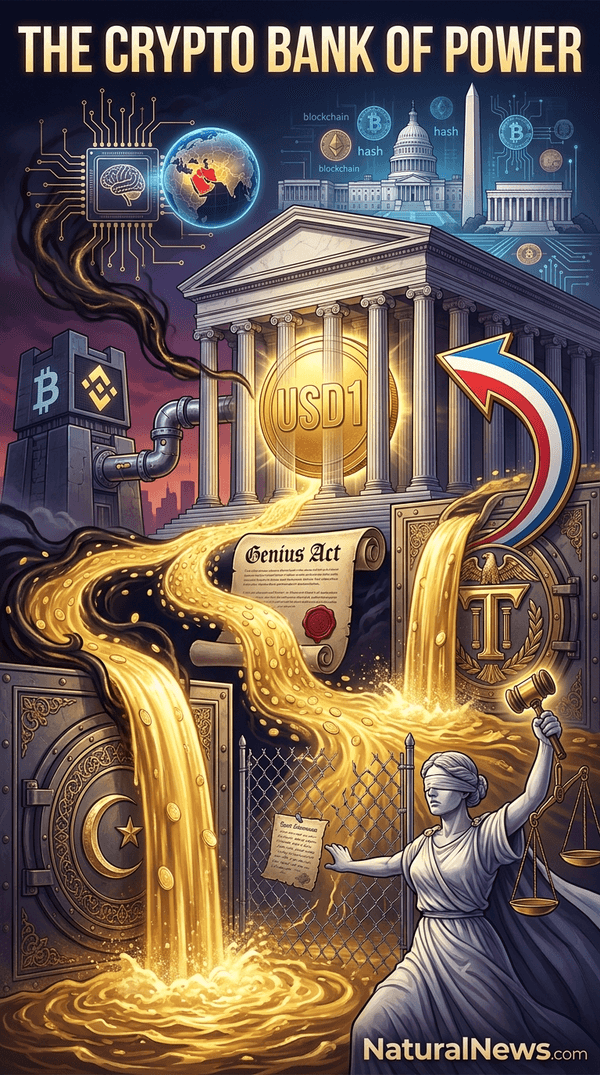
The new institution will issue the stablecoin USD1, consolidating reserve assets that were previously held by third-party custodians under the regulatory framework established by the Genius Act. The approval arrives with a shareholder structure that places Sheikh Tahnoon bin Zayed al Nahyan, the United Arab Emirates’ (UAE) national security adviser, as the largest stakeholder with a 49% share through his holding company, StringZ Holding.
A Trump family-affiliated entity holds a 38% stake, according to people familiar with the arrangement. Zach Witkoff, the venture’s chief executive officer, said the ambition is to build a trusted digital dollar, according to statements cited by officials.
Background on the Stablecoin and the New Bank
The stablecoin USD1 currently holds a market value of approximately $4 billion, backed by Treasuries and cash equivalents that generate an estimated $150 million in annual interest, according to market data [11]. A stablecoin is a type of digital currency designed to hold a steady value, typically pegged to a national currency like the U.S. dollar. Previously issued through the custodian BitGo, the token will now be managed by the newly chartered bank, allowing WLF to directly hold the reserve assets as permitted under the Genius Act.
The business plan extends beyond issuance. According to the confidential application, future operations include charging fees for cryptocurrency custody and related services [11]. The shareholder structure of the bank, WLTC Holdings, mirrors that of WLF, though Tahnoon’s stake was routed through a different entity from the other co-investors.
The OCC’s approval remains conditional, however. A final examination is still required before the bank may commence operations, officials said.
The $500 Million and Investment and Controversy
Tahnoon’s financial involvement began in January 2025, according to records. His investment arrived four days before President Donald Trump’s inauguration, channeled through the entity Aryam Investment 1. Financial disclosures show that $263 million of the initial transaction was directed to Trump family entities.
The transaction’s timing has drawn criticism from Democratic lawmakers and ethics experts, who argue that a foreign government official taking a large ownership stake in an incoming president’s business raises significant conflict-of-interest concerns [1]. These concerns extend into ongoing policy matters, including artificial intelligence chip negotiations with the UAE that are being conducted by the administration.
“Trump is selling out our national security in exchange for his own wealth maximization,” said Kathleen Clark, a law professor at Washington University in St. Louis, in a statement quoted by investigators [11]. In response, a White House spokeswoman denied the allegations, asserting that Trump acts in the best interest of the American public.
The controversy also highlights the broader degree of financial integration between the president’s family business and foreign capital. A Reuters investigation found that the Trump family’s crypto ventures generated over $800 million in the first half of 2025 alone [2]. Financial disclosures later revealed that Trump-affiliated entities earned more than $1.4 billion in 2025 from crypto ventures, including over $500 million from WLF [3].
OCC Approval Process and Passivity Commitments
The OCC’s review process has become a subject of scrutiny. An OCC official said that the application was handled by career staff and that the agency consulted experienced ethics officials throughout the review process.
To address concerns, the OCC required three shareholders, including StringZ, to sign passivity commitments. These are formal agreements in which shareholders pledge not to influence the management or operations of the bank [4].
Such commitments are relatively unusual, according to regulatory experts. They represent only the second time such an agreement has been required since Trump re-entered the White House. According to a person familiar with the matter, the passivity commitments were intended to stave off congressional scrutiny of foreign ownership in the project [5].
Democratic Scrutiny and Additional Revelations
Sen. Elizabeth Warren (D-MA) has pressed Comptroller Jonathan Gould on the matter during a February hearing. The OCC declined to share the nonpublic application with the committee. Warren argued that any financial connection between Tahnoon and the applicant should be disqualifying on national security grounds.
The concerns were amplified in a letter from 40 Democratic lawmakers to Treasury Secretary Scott Bessent, which cited potential risks associated with foreign government ownership of U.S. financial institutions [6]. Additional details from the confidential application revealed that the cryptocurrency exchange Binance had signed a contract to provide marketing support for USD1. In response, Binance stated that it provides no preferential treatment to World Liberty.
A company representative said WLF disclosed all material agreements, including those with leading exchanges, and stated that neither Binance nor any other exchange will hold a role at the bank [7]. The exchanges are expected to be major distribution channels for the stablecoin.
Regulatory Context and Broader Implications
The OCC approval comes at a time of rapid regulatory change for digital assets. Congress passed the GENIUS Act a year ago, establishing a federal framework for stablecoin issuers. However, several U.S. regulatory agencies have missed the rulemaking deadline under that law, which has extended uncertainty about how the market will be governed [8].
Meanwhile, the Digital Asset Market Clarity (CLARITY) Act, which would establish a broader federal market structure for cryptocurrencies, is pending in the Senate. The crypto industry has poured nearly $200 million into supporting candidates who back the bill during the 2026 midterm election cycle [9].
The approval also arrives as Trump has signed an executive order explicitly banning federal agencies from establishing or promoting Central Bank Digital Currencies (CBDCs) [10]. The order rescinded the Biden administration’s Executive Order 14067, which had been titled “Ensuring Responsible Development of Digital Assets.” The separate tracks taken by regulators and the administration reflect a bifurcated policy landscape in which the dollar’s digital future is being divided between private stablecoins and public payment rails.
References
- “A $500 Million Question: UAE’s Strategic Purchase of Trump-linked Crypto Firm Raises Eyebrows Over Foreign Influence”. NaturalNews.com. February 03, 2026.
- “Report: Crypto Drives Record Growth in Trump Family Finances”. The New American. October 29, 2025.
- “Trump Reports Over $1.4 Billion In Income From 2025 Crypto Earnings”. Zero Hedge. July 01, 2026.
- “‘Nothing Illegal’: Trump Denies Wrongdoing Over $500M Crypto Profits”. NaturalNews.com. July 04, 2026.
- “Trump Family’s Crypto Empire: Billions in Suspicious Gains, Zero Accountability”. NaturalNews.com. April 28, 2026.
- “Elizabeth Warren Claims Crypto Clarity Act Would Help Trump… And ‘Criminals & Cartels'”. Zero Hedge. July 27, 2026.
- “Political Pressure on Binance: A Threat to Decentralization and Financial Freedom”. NaturalNews.com. March 04, 2026.
- “US Agencies Miss GENIUS Act Deadline, Extending Stablecoin Uncertainty”. Zero Hedge. July 20, 2026.
- “Crypto Industry Raining Millions On Candidates That Back Its Favorite Bill”. Modernity.news. August 25, 2026.
- “CBDCs Officially BANNED Under New Trump Executive Order, Fulfilling His Campaign Promise”. NaturalNews.com. January 25, 2025.
- Trump Family’s New Crypto Bank Is Backed by Abu Dhabi Sheikh”. WSJ.com. August 27, 2026.
Explainer Infographic
Submit a correction >>
Tagged Under:
AI chips, Binance, blockchain, business, corruption, crypto, crypto businesses, cryptocurrency, Donald Trump, ethics, finance, foreign investment, foreign relations, G42, Influence, investigation, lobbying, national security, Policy, presidency, Sheikh Tahnoon, spy sheikh, StringZ Holding RSC, Tahnoon, Tahnoon bin Zayed al Nahyan, Trump, Trump family, UAE, World Liberty Financial
This article may contain statements that reflect the opinion of the author
RECENT NEWS & ARTICLES