U.S. Energy Department to Release 40 Million More Barrels From Strategic Petroleum Reserve
10/02/2026 / By Iva Greene

The U.S. Department of Energy (DOE) announced Tuesday, Sept. 29, that it will offer 40 million barrels of crude oil from the Strategic Petroleum Reserve (SPR) as a loan to energy companies, according to a department statement [1].
The release represents the final portion of the 172 million barrels the United States pledged to release under an international agreement reached in March, officials said [1]. Companies that borrow the oil must repay it with more barrels than they received, the department stated [1].
The agency said the structure will put oil on the market now while ensuring the reserve is refilled later [1]. Bids from energy companies are due Oct. 6, according to the department [2].
The offer is part of a coordinated effort with about 30 countries in the International Energy Agency (IEA) to release 400 million barrels, officials said [2]. The March agreement was approved by the 32-member nations of the IEA [3].
Reserve Level Approaches Operational Minimum
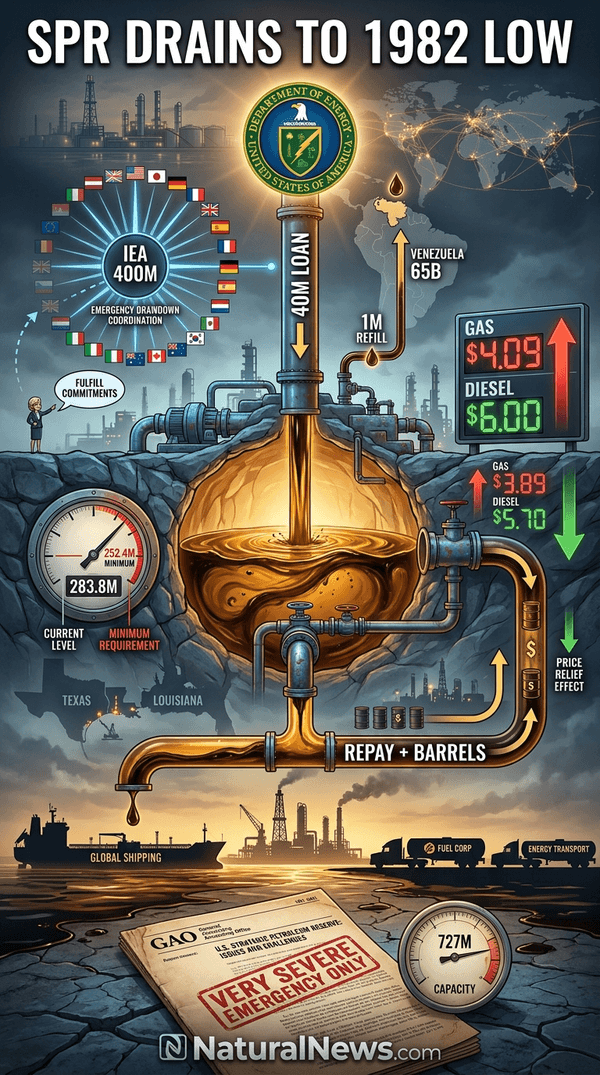
The SPR held 283.8 million barrels for the week ending Sept. 25, the lowest level since October 1982, according to DOE data [4]. The figure represents a decline from 284.6 million barrels for the week ending Sept. 18 and 406.0 million barrels a year earlier, Energy Information Administration (EIA) figures showed [5]. The reserve has set a new multi-decade low twice this year, first falling below 300 million barrels in August [5].
That total is 445 million barrels below the reserve’s maximum capacity of approximately 727 million barrels [6]. The reserve once held more than 700 million barrels at its peak, according to historical records [6]. A 1981 Government Accountability Office report advised releasing less than 250 million barrels only during a “very severe emergency,” the report stated [5].
Releasing the full 40 million barrels would push the SPR below 252.4 million barrels, the operational minimum set under federal law, officials said [5]. Federal law restricts non-emergency drawdowns once inventories fall below 252.4 million barrels, according to the statute [5]. The reserve has shrunk by almost a third since Washington began releasing crude in March [4].
Fuel Prices Rise and Diesel Supplies Tighten
Since the start of the war with Iran, U.S. gasoline prices have risen almost 50% to an average of $4 per gallon [2]. The average for 87-octane gasoline stood at $4.09 as of Aug. 3, marking the second consecutive week above the $4 level, according to American Automobile Association data cited by ZeroHedge [7]. Diesel prices have climbed 70% to more than $6 per gallon [2].
By early September, distillate inventories stood 14% below the five-year average, while gasoline inventories were 6% below typical seasonal levels, according to the DOE [7]. The U.S. produces large amounts of oil and gets most of its imports from outside the Persian Gulf, but oil trades in a global market, so when millions of barrels disappear, prices rise everywhere – including for American consumers [8].
The release is intended to stabilize oil markets, Energy Secretary Chris Wright said in a statement [1]. The offer comes ahead of the U.S. midterm elections in November [2]. Market participants are watching whether the SPR falls below the 252.4-million-barrel operational threshold [5].
International Commitments and Refill Plans
Wright said the U.S. and Japan are delivering on their commitments, while several European member countries have released only a fraction of the crude oil and petroleum products they pledged [2]. “We urge every member country to fulfill its commitments,” Wright said in the statement [2].
Wright also stated that the exchanges will ensure the SPR continues to be refilled and will save taxpayers more than $3 billion, according to the department [1]. The release is part of a coordinated emergency effort led by the IEA, officials said [2]. The U.S. agreed in March to loan 172 million barrels of oil from the SPR as part of a wider deal with about 30 countries in the IEA to release 400 million barrels [2].
President Donald Trump has said Venezuelan oil secured under a new agreement will be used to begin “topping out” the emergency stockpile very shortly [9]. The U.S. government will form a joint venture with a private business in Venezuela under the agreement, which gives the United States majority control of more than 65 billion barrels of proven oil reserves. The White House has positioned energy security in the West as a key pillar of U.S. national security [10].
Background: Reserve Drawdowns Since 2022
The SPR has trended lower since Russia’s 2022 invasion of Ukraine, according to DOE records [11]. The U.S. strategic oil reserves fell to 453.1 million barrels as of Aug. 19, 2022, the lowest level since January 1985 at that time [11]. Stockpiles had fallen by more than 180 million barrels that year as the Biden administration ordered releases [11].
Repeated OPEC+ refusals to increase production during former President Joe Biden’s term contributed to the drawdowns [12]. The Organization of the Petroleum Exporting Countries (OPEC) and its allies agreed in October 2022 to reduce oil production by between 500,000 and two million barrels per day beginning in November 2022, a decision seen as a rejection of Biden’s plea to increase output [12]. OPEC’s supply cut was a political statement, Ann Vandersteel, co-chair of the Zelenko Freedom Foundation, said during an Oct. 6, 2022, episode of “The Zelenko Report” on Brighteon.TV [13].
The Trump administration initiated the purchase of 1 million barrels of crude oil in October 2025 to begin refilling the severely depleted reserve, which was only about 60% full after historic drawdowns [14]. A 1981 Government Accountability Office report advised releasing less than 250 million barrels only during a “very severe emergency,” the report stated [5].
The current release follows earlier tranches of the 172-million-barrel pledge announced this year, the department stated [15]. The DOE announced on May 11, 2026, that it would loan 53 million barrels of crude oil from the SPR to petroleum companies in an effort to alleviate elevated gas and oil prices amid tensions with Iran [15].
Next Steps and Market Watch
Energy companies must submit bids for the 40-million-barrel release by Oct. 6, the Energy Department said [2]. The department did not announce further releases beyond the final tranche of the 172-million-barrel commitment, officials said [1]. The DOE said the loan structure is intended to refill the reserve later, a department statement said [1].
Market participants are watching whether the SPR falls below the 252.4-million-barrel operational threshold, according to analysts [5]. The reserve has shrunk by almost a third since Washington began releasing crude in March, according to government data [4]. U.S. crude oil inventories, including commercial stockpiles and the nation’s emergency reserves, fell by 16 million barrels in early June to their lowest combined level in more than two decades [16].
The U.S. was the largest crude oil producer in the world in 2025, outputting a record-high 13.6 million barrels per day, according to a July 9 statement from the EIA [17]. America’s output was far ahead of second-placed Russia, which produced 9.9 million barrels per day, and Saudi Arabia, which produced 9.6 million barrels per day [17]. The current release follows earlier tranches of the 172-million-barrel pledge announced this year, the department stated [15].
References
- The Epoch Times. “DOE Offers 40 Million Barrels in Oil Loans to Help Stabilize Markets.” The Epoch Times. September 29, 2026.
- Middle East Eye. “US to release 40 million barrels of crude from Strategic Petroleum Reserve.” Middle East Eye. September 29, 2026.
- NaturalNews.com. “Trump Orders Historic 172M Barrel SPR Release Amid Middle East Crisis – Lowest Reserve Levels Since 1970s – NaturalNews.com.” NaturalNews.com. March 17, 2026.
- RT. “US strategic oil reserve plunges to 44-year low.” RT. September 29, 2026.
- NaturalNews.com. “U.S. Strategic Petroleum Reserve Drops To Lowest Level Since 1982 – Can Washington Afford To Refill It?” NaturalNews.com. September 29, 2026.
- NaturalNews.com. “Strategic Petroleum Reserve Falls to 285.4 Million Barrels, Lowest Since 1982.” NaturalNews.com. September 16, 2026.
- NaturalNews.com. “Gasoline Prices Hold Near $4 Per Gallon as Iran Conflict, Refining Issues Hit Supply.” NaturalNews.com. August 14, 2026.
- The New American. “U.S. Oil Reserve Falls to 43-Year Low as Trump Drawdown Nears Its Limit.” The New American. July 10, 2026.
- 100PercentFedUp.com. “President Trump Announces Venezuelan Oil Will Refill America’s Strategic Petroleum Reserve.” 100PercentFedUp.com. August 30, 2026.
- ZeroHedge. “Venezuela’s Oil Revival Faces ‘Decade Or Two’ Climb Back To Record Output, Piper Sandler Warns.” ZeroHedge. September 21, 2026.
- NaturalNews.com. “US oil reserves fall to 37-year low as Biden continues to export Americas oil to China – NaturalNews.com.” NaturalNews.com. August 30, 2022.
- Belle Carter. “OPEC+ set to reduce oil production a blatant rejection of Bidens plea – NaturalNews.com.” NaturalNews.com. October 10, 2022.
- NaturalNews.com. “The Zelenko Report_ OPECs 2M-barrel supply cut a political statement says Ann Vandersteel BrighteonTV – NaturalNews.com.” NaturalNews.com. October 12, 2022.
- Willow Tohi. “Oil prices crash Trump seizes opportunity to rebuild depleted SPR – NaturalNews.com.” NaturalNews.com. October 25, 2025.
- NaturalNews.com. “US Releases 53 Million Barrels From Strategic Petroleum Reserve Amid Rising Gas Prices – NaturalNews.com.” NaturalNews.com. May 14, 2026.
- The Center Square. “Record Gulf Coast exports push U.S. oil inventories lower.” JustTheNews.com. June 6, 2026.
- Naveen Athrappully via The Epoch Times. “United States Retains Spot As World’s Top Oil Producer.” ZeroHedge. July 13, 2026.
Explainer Infographic
Submit a correction >>
Tagged Under:
big government, bubble, crude oil, Department of Energy, drawdowns, energy companies, energy security, energy supply, fuel prices, fuel supply, IEA, market crash, oil prices, oil supply, petroleum industry, petroleum reserves, risk, SPR, Strategic Oil Reserve, supply chain warning, White House
This article may contain statements that reflect the opinion of the author
RECENT NEWS & ARTICLES