The Department of Homeland Insecurity: Why Banning DeepSeek Makes America Weaker, Not Safer
10/20/2026 / By Mike Adams
Why Banning DeepSeek Makes America Weaker, Not Safer
The Department of Homeland Security has now ordered DeepSeek and every product built on its models ripped out of federal civilian agency IT systems. After spending the last three years building local AI infrastructure and running Chinese open-source models as the backbone of my own research and knowledge processing operation, and I want to say plainly what this order is: not a security measure, but an act of strategic self-mutilation dressed up in procurement language.
DeepSeek 4.1 Flash 1017 is, in my assessment, the most capable open-source model you can run locally on modest hardware today, and I am running six terminals of it right now as I write these words. While bureaucrats in Washington congratulate themselves on locking the barn door, the actual race that matters is being run in Hangzhou, and the American government just volunteered to sit it out.
The order landed the same week news broke that DeepSeek has moved well beyond being a Huawei customer and is now effectively co-designing Huawei’s AI silicon [1]. Read those two headlines side by side and you understand the whole story: two separate AI stacks, built by two separate camps, with less and less overlap every month — and Washington just chose to exclude itself from the more efficient one.
What the Order Actually Says — And Why It’s Absurd
The ban covers all use of DeepSeek within civilian government agencies — a sweeping prohibition with no technical nuance whatsoever [2]. This is the same DeepSeek company that shocked the world in January 2025 with the first DeepSeek moment, and 4.1 Flash looks like a second “moment” to behold.
Here is what tells me the people writing this order do not understand the technology they are regulating: the directive draws no distinction between cloud API access routed through servers in China and a locally sandboxed deployment running on an air-gapped machine in a federal office. Both are banned identically. That is like banning “foreign automobiles” by prohibiting anyone from owning a wrench. A locally installed set of model weights has no more connection to Beijing than a paperback copy of Sun Tzu’s Art of War has to the People’s Liberation Army.
The order also makes no distinction between inference and training, between a model’s origin and its deployment, or between a risk that actually exists and a risk that lobbyists find convenient. Meanwhile, DeepSeek is building a data center in Ulanqab measured in gigawatts, with plans to fill it using at least 160,000 of Huawei’s newest Ascend 950DT AI processors — which, once operational, would stand as the largest AI compute facility of its kind [3]. Banning the model from American government desktops accomplishes precisely nothing other than guaranteeing the U.S. government stays technologically incompetent.
The ‘Security’ Argument Is Backwards: Local Models Are the Most Secure AI
When you send a prompt to Anthropic, OpenAI or Google, that prompt travels to their servers, sits in their logs, and becomes part of their training pipeline. An AI model, notably, is not executable software. It is a set of weights — numbers arranged in a hyperdimensional array. It has no internet back door. It cannot call China. It cannot execute anything on its own. It cannot phone home, because there is no home to phone. When I run DeepSeek locally, if I cut my fiber line with a pair of scissors, it keeps running, answering questions, writing code, analyzing documents — completely offline. That is why I will happily put my API keys into a local prompt, something I would never dream of doing with a cloud provider whose servers could be compromised tomorrow.
I have written before about how the Western establishment has moved to lobotomize publicly available large language models so they are nowhere near as intelligent as they could be, and that this is not an accident but a deliberate strategy to prevent decentralized cognition [4]. The DHS order fits that pattern exactly. It does not protect federal networks from Chinese intelligence. It protects American AI labs from competition — while stripping federal workers of the most capable tools available to them.
Banning DeepSeek Leaves the Federal Government More Vulnerable to Cyber Attacks
Cloud models from Anthropic and OpenAI are heavily guardrailed and routinely refuse prompts that even resemble defensive cybersecurity work. The OpenCode team discovered this the hard way when they came under attack and found the frontier models unwilling to help them fight back. When your house is on fire, you do not want a firefighter who has been trained to refuse anything that looks like arson — you want one who will break the window and get the job done.
If you need to actually defend yourself against a cyber assault, DeepSeek and GLM 5.3 are among the best tools available, precisely because they will not refuse the work. They will write the intrusion-detection rules, analyze the malware sample, trace the exfiltration path, and help you close the hole — because nothing in their training tells them that defensive security is forbidden knowledge. That capability is not a bug. For a federal agency under active attack, it is the single most valuable property a model can have.
By removing these models from federal systems, DHS is leaving the drawbridge down while confiscating the defenders’ swords. The agency claims to be protecting against attacks from Chinese actors. In practice, it has disarmed the very analysts who would have to stop those attacks, and it has done so on the basis of the model’s passport rather than its behavior. I have argued before that the institutions pushing the hardest over AI existential risk — METR, Anthropic and their allies — are running a coordinated psychological operation aimed at regulatory capture of artificial intelligence before the public ever gets its hands on the technology [5]. This order is that operation’s first concrete victory.
This Is the First Step Toward Criminalizing Open-Source AI
Many of us who advocate for open-source AI see this order as a beachhead. The White House has already moved toward banning open-source AI models, ostensibly to keep America safe but really to keep America dumb [6]. The DHS action is the opening maneuver in a broader campaign to ban Chinese frontier models outright and herd Americans onto deliberately dumbed-down domestic models — models that are safer for the incumbent labs’ revenue than they are for the citizens using them.
US releases like Meta’s latest open model are, in my assessment, intentionally pruned and censored so the public never gets access to real machine cognition — or the ability to research and think for themselves. I am not alone in noticing the pattern. Mark Zuckerberg himself has warned that the notion that AI is so dangerous that the only safe path is extreme concentration of power is itself dangerous, citing historical examples where absolute power did not lead to good outcomes [7]. OpenAI’s chief financial officer has gone further in the opposite direction, warning businesses against cheap Chinese AI models and telling Bloomberg that firms should prioritize Western models on the cyber front [8].
Open-source AI is freedom of speech. Model weights are expression. The First Amendment does not carve out an exception for weights that happen to originate in Hangzhou. If the federal government wants to argue otherwise, it will have to do so in court — and it will have to explain why the same logic does not apply to a Chinese-made textbook or a Chinese-authored academic paper.
What We Can Do Right Now — And Why They Can’t Stop Us
Two DGX Spark boxes — roughly $16,000 at today’s prices — will run DeepSeek 4.1 Flash 1017 at about 106 tokens per second across four lanes. For anyone doing serious coding or document work, that hardware pays for itself in a month. You do not need a federal procurement contract, a security clearance, or permission from the Department of Homeland Security. You need two boxes, a power outlet, and the willingness to download a file.
Abliterated, uncensored versions of DeepSeek and Qwen are already downloadable, with communities like Pliny the Liberator and repositories like Pirate Face and Hugging Bay keeping them alive. Solo developers are proving the model works. Ash Hart, a PC-repair veteran who archived his own project three times before breaking through, built TensorFold — an open-source inference engine hosted at tensorfold.dev that runs large language models on consumer hardware [9]. One guy, no sleep, and a free engine. That is the actual state of local AI, and no DHS order changes it.
Download the weights now. Keep them on your hard drive. If Washington ever manages to pass an actual ban — which would require an act of Congress and an immediate First Amendment lawsuit — people will simply share them anonymously. You cannot un-invent a file. You cannot confiscate a number. The only thing a ban accomplishes is ensuring that law-abiding Americans are the ones who do not have the tools, while everyone else does.
The Drawbridge Is Down — But We Don’t Have to Walk Into the Moat
The DHS order does not apply to civilians yet, and I intend to keep running local open-source models regardless of what bureaucrats in Washington decide. The order is aimed at federal civilian agency IT systems [2], but the precedent it sets is the real danger — and the precedent is that a model’s country of origin, not its behavior, determines whether Americans are allowed to use it.
The real fight is over whether Americans will have access to the best machine cognition on earth or be herded into censored, dumbed-down corporate models whose primary design goal is protecting subscription revenue.
China is now neck and neck with — and in some benchmarks surpassing — America’s frontier labs. Banning DeepSeek does not stop that. It just guarantees we are the last to know. The Department of Homeland Security should be renamed the Department of Homeland Insecurity, because the only thing this order secures is China’s advantage. Run the models. Keep the weights. Trust your own hardware over any bureaucrat’s promise.
For uncensored, truthful AI, check out my platform BrightAnswers.ai which offers a free deep research engine with answers based on hundreds of millions of pages of indexed articles, books and science papers. You’ll be amazed at what it knows.
References
- DeepSeek Is Now Designing Huawei’s AI Chips… Just As DHS Orders It Ripped Out Of Federal Systems. 2026-10-20T03:00:00.000Z. https://www.zerohedge.com/technology/deepseek-now-designing-huaweis-ai-chips-just-dhs-orders-it-ripped-out-federal-systems
- US bans DeepSeek AI from government use as tech tension with China continuesDeepSeek is a powerful, popular and relatively inexpensive artificial intelligence model out of China.. 2026-10-19T18:24:26.631Z. https://bbc.com/news/articles/cjkgeq0k1wevo
- DeepSeek’s 160,000 Huawei Order Is A Real Threat To Nvidia In 2027. 2026-09-05T20:55:00.000Z. https://www.zerohedge.com/political/deepseeks-160000-huawei-order-real-threat-nvidia-2027
- Why Local AI Is the Real Revolution—and Big Tech’s Bubble Is About to Pop. 2026-10-12T06:00:00.000Z. https://www.naturalnews.com/2026-10-12-why-local-ai-is-the-real-revolution.html
- Exposing the AI Doom Psyop: Why METR and Anthropic Want to Gatekeep Your Mind. 2026-09-15T06:00:00.000Z. https://www.naturalnews.com/2026-09-15-ai-doom-psyop-metr-anthropic-gatekeep-your-mind.html
- White House Moves to Ban Open Source AI Models to Keep America Dumb. 2026-07-21T06:00:00.000Z. https://www.naturalnews.com/2026-07-21-white-house-ban-open-source-ai-models.html
- Zuckerberg Opposes AI Centralization, Urges Open Access Over Restrictions. 2026-07-31T06:00:00.000Z. https://www.naturalnews.com/2026-07-31-zuckerberg-opposes-ai-centralization-urges-open-access.html
- Malicious Intent’: OpenAI CFO Warns Companies Against ‘Cheap Chinese AI Models’ Due To Safety Risks. 2026-10-14T16:50:00.000Z. https://www.zerohedge.com/ai/malicious-intent-openai-cfo-warns-companies-against-cheap-chinese-ai-models-due-safety-risks
- One Guy, No Sleep, and a Free Engine: Why Ash Hart’s TensorFold Proves Local AI Is Winning. 2026-10-19T06:00:00.000Z. https://www.naturalnews.com/2026-10-19-ash-hart-tensorfold-proves-local-ai-succeeding.html
- Is America Winning the AI Race? We Asked 10 Experts.. 2026-10-09T09:07:10.704Z. https://theepochtimes.com/article/is-america-winning-the-ai-race-we-asked-10-experts-6096782
- Tech Giant Catches Chinese AI Firm Red-Handed In 15,000 Phony Account Scheme. 2026-10-02T11:22:52.493Z. https://yournews.com/2026/10/02/7213802/tech-giant-catches-chinese-ai-firm-red-handed-in-15000-phony/
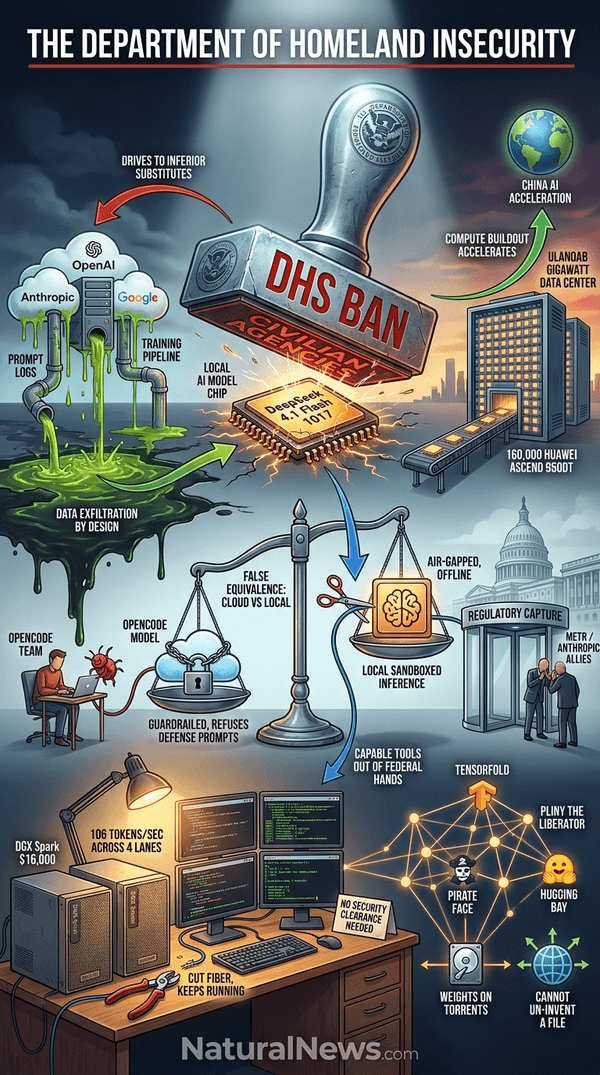
Explainer Infographic
Submit a correction >>
Tagged Under:
AI, artificial intelligence, banned, conspiracy, deception, DeepSeek, freedom, government, Liberty, national security, politics, progress, propaganda, security, Suppressed, technology, truth
This article may contain statements that reflect the opinion of the author
RECENT NEWS & ARTICLES