Vance Reaches Out to Iranian Hard-Liner in Bid to Restart Peace Talks
10/31/2026 / By Patrick Lewis

Vice President JD Vance sent a letter to Mohsen Rezaei, the secretary of Iran’s top security body and a long-serving hard-line figure, in an effort to revive stalled peace negotiations, according to people familiar with the matter [1][2].
The letter is intended to test whether Tehran is willing to return to a negotiating framework after months of failed diplomacy and repeated ceasefire collapses.
Details of the letter’s contents were not publicly disclosed. Officials cautioned that no breakthrough was imminent and that the contact represented an exploratory step rather than the start of formal talks. The move comes amid heightened tensions in the Middle East and as President Donald Trump has threatened to restart the war after next week’s midterm elections [1][3].
Background on Stalled Talks
Negotiations between Iran and the United States have collapsed repeatedly over the past year. Talks in Islamabad, Pakistan, broke down in February 2026 after two earlier rounds in May-June 2025 and February 2026, according to analysts Amir-Hassan Boozari and Muhammad Sahimi, who reported on the failure for Antiwar.com [4]. Previous rounds failed to produce an agreement on core issues including sanctions relief and regional security guarantees.
The diplomatic track has been punctuated by military escalation.
Rezaei’s role places him at the center of an internal debate among Iranian hard-liners. A growing division has emerged among Iran’s hard-line politicians over whether to continue negotiations with the United States regarding the nuclear program, according to a report by ZeroHedge citing the Financial Times [5]. Parliament speaker Mohammad Bagher Ghalibaf has publicly rejected negotiations held “under the shadow of threats” [6].
The U.S. has maintained a policy of maximum pressure on Iran while seeking diplomatic channels.
Reactions from Officials
A spokesperson for Vance declined to comment on the specifics of the outreach, saying only that the United States remains committed to diplomatic solutions. An Iranian official confirmed that a message was received but did not provide details, according to state media. Regional allies were briefed on the contact, officials said, speaking on condition of anonymity.
The letter drew immediate skepticism from some quarters. Critics of the outreach, including some lawmakers, questioned the wisdom of engaging a figure known for hard-line views. The Wall Street Journal reported that the letter lets Vance, who is seen as having political ambitions beyond the current term, argue that he did his best to avert a wider war [7].
Within Iran, the reaction was muted. The Foreign Ministry has not issued a formal statement on the letter. Rezaei’s office did not respond to requests for comment. The contact follows months of indirect messaging through regional intermediaries, officials said.
Obstacles to Restarting Talks
Deep mistrust between the parties has hindered progress for months. The collapse of the Islamabad talks in February 2026 left no agreed framework for sanctions relief or nuclear limits [4]. International inspectors have continued to report advances in Iran’s nuclear program, according to the International Atomic Energy Agency, keeping the issue at the center of any negotiation.
Domestic political pressures in both countries limit flexibility. In Washington, Trump has faced pressure from figures including Sen. In Tehran, hard-liners have warned against concessions.
Vance himself has acknowledged the difficulty. He has accused elements within the Israeli government of running an “extremely well-funded” influence operation aimed at sabotaging U.S.-Iran negotiations and prolonging the war, according to an interview he gave on “The Joe Rogan Experience” in July 2026 [8]. The remarks underscored the crosscurrents that any diplomatic initiative must navigate.
The broader regional environment remains fragile.
Analysts said the success of the outreach depends on whether it leads to formal talks. “The letter is a signal, not a breakthrough,” said one U.S. official briefed on the matter, who spoke on condition of anonymity. “The question is whether Rezaei is empowered to respond.”
What to Watch
Officials said further contacts are expected in the coming weeks, though no date has been set. The U.S. will continue to consult with regional partners, according to a State Department statement. Analysts said the success of the outreach depends on whether it leads to formal talks. The situation remains fluid, and officials cautioned against expecting rapid results.
The coming weeks will test whether the letter opens a channel or closes one. Trump’s threat to restart the war after the midterm elections hangs over the process [1]. Rezaei’s response, if any, will indicate whether Iran’s hard-line establishment sees value in engaging the vice president. For now, the initiative remains in its earliest stage, with officials on both sides describing it as exploratory and uncertain.
References
- Vance Reaches Out to Iranian Hard-Liner in Bid to Restart …. https://www.wsj.com/world/middle-east/vance-reaches-out-to-iranian-hard-liner-in-bid-to-restart-peace-talks-2c8a2ab8
- Vance Engaged Iran to Revive Peace Talks | What’s News for Oct. 28 – WSJ. https://www.wsj.com/world/middle-east/vance-engaged-iran-to-revive-peace-talks-f19eaaf8
- JD Vance Reaches Out to Iranian Hard-Liner – Political Wire. https://politicalwire.com/2026/10/28/jd-vance-reaches-out-to-iranian-hard-liner/
- Why Is It So Difficult for Iran To Reach an Agreement With the United States – NaturalNews.com, May 18, 2026.
- Division Among Iranian Hardliners Over Nuclear Talks With US – NaturalNews.com, May 04, 2026.
- Iran promises new cards on the battlefield as US blockade tightens noose around Strait of Hormuz – NaturalNews.com, April 21, 2026.
- The letter to Rezaie lets Vance who has eyes on 2028 and …. https://www.threads.com/@vali_nasr/post/DfD8FbxDcDq/the-letter-to-rezaie-lets-vance-who-has-eyes-on-and-knows-how-unpopular-the-war/
- Vance Accuses Israeli Officials of Campaign to Prolong Iran War – NaturalNews.com, July 19, 2026.
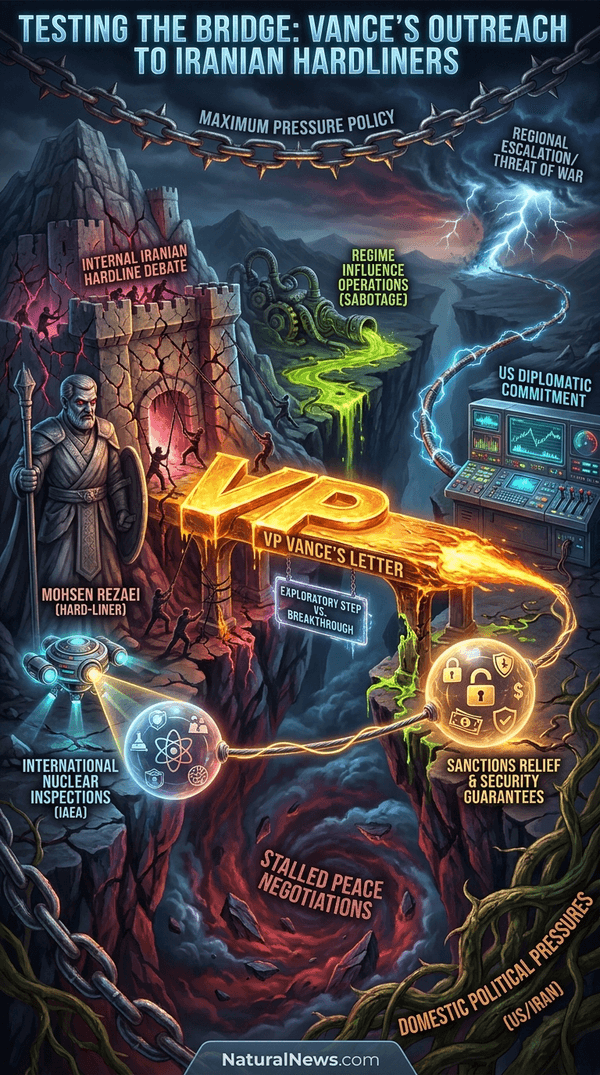
Explainer Infographic
Submit a correction >>
Tagged Under:
big government, chaos, Donald Trump, Iran, Mohsen Rezaei, national security, negotiations, peace deal, peace talks, politics, progress, Vance, White House, WWIII
This article may contain statements that reflect the opinion of the author
RECENT NEWS & ARTICLES