House passes resolution to end Trump’s tariffs on Canada
02/13/2026 / By Laura Harris

- On Feb. 11, the U.S. House passed a 219 to 211 resolution to end President Trump’s tariffs on Canada, with six Republicans joining nearly all Democrats; Rep. Jared Golden (D-Maine) was the lone Democrat opposed. The measure now heads to the Senate.
- Trump imposed the tariffs in 2025, citing border security and fentanyl concerns, later pausing them for a month after Canada pledged stronger border measures and exempting United States–Mexico–Canada Agreement (USMCA)-compliant goods.
- Despite adjustments to the policy, lawmakers from both parties have sought to roll back the duties, arguing they harm trade with one of America’s largest trading partners.
- Trade strains escalated after Canada struck a deal with China allowing more Chinese electric vehicles into Canada in exchange for lower Chinese tariffs on Canadian canola, prompting Trump to threaten 100% tariffs on Canadian goods.
- Treasury Secretary Scott Bessent warned against Chinese EVs entering the U.S. via Canada, while Trump criticized Prime Minister Mark Carney’s remarks at the World Economic Forum (WEF), underscoring deepening economic and diplomatic tensions.
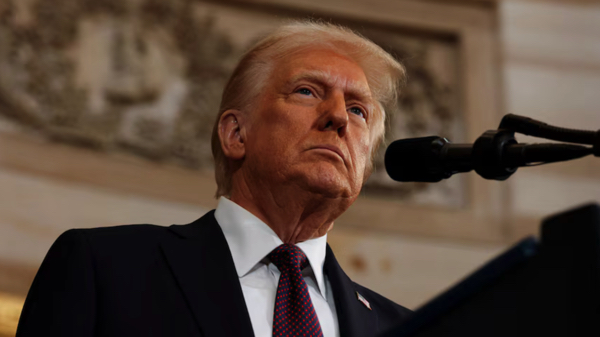
The U.S. House of Representatives on Feb. 11 passed a resolution aimed at ending President Donald Trump’s tariffs on Canada, one of the United States’ largest trading partners.
In 2025, Trump imposed tariffs on Canada as part of the president’s broader global trade agenda, with the administration citing border-security concerns and the flow of fentanyl into the United States. Trump paused the levies for one month after Canada committed to strengthening security along the U.S.-Canada border.
The president later amended his executive order to exempt goods compliant with the United States–Mexico–Canada Agreement (USMCA), softening the impact on certain cross-border trade.
But despite those adjustments, lawmakers in both parties have pushed to unwind the import duties on Canada.
In line with this, the lower chamber passed a resolution that would end Trump’s tariffs on Canada in a 219 to 211 vote. Six Republicans, including Reps. Don Bacon of Nebraska, Kevin Kiley of California, Thomas Massie of Kentucky, Jeff Hurd of Colorado, Brian Fitzpatrick of Pennsylvania and Dan Newhouse of Washington joined all but one Democrat in supporting the resolution. Rep. Jared Golden (D-Maine) was the lone member of his party to vote against it.
With passage in the House, the resolution now heads to the Senate. If approved there, it would be sent to the president’s desk for his signature.
Trade relations between U.S. and Canada deteriorate amid China deal
Trade relations between the U.S. and Canada have deteriorated sharply following Ottawa’s new trade agreement with China.
The friction intensified after Canada reached a deal with Beijing that would allow thousands of additional Chinese electric vehicles into the Canadian market in exchange for reduced Chinese tariff rates on Canadian canola exports. The agreement drew swift criticism from Trump, who threatened to impose a 100% tariff on Canadian goods entering the United States.
“If ‘Governor’ Carney thinks he is going to make Canada a ‘Drop Off Port’ for China to send goods and products into the United States, he is sorely mistaken,” Trump posted on his Truth Social platform in January.
“China will eat Canada alive, completely devour it, including the destruction of their businesses, social fabric and general way of life.”
Appearing before the Senate Banking Committee on Feb. 5, Treasury Secretary Scott Bessent reinforced the administration’s concerns, telling lawmakers that the U.S. could not allow its “northern border be used as a way for Chinese EVs” to enter the U.S. market.
Trump also addressed Prime Minister Mark Carney’s speech at the World Economic Forum (WEF) in Davos. Trump offered a pointed response, suggesting Canada benefits disproportionately from its relationship with the U.S. after Carney signaled a broader realignment in global trade relationships.
“I watched your prime minister yesterday. He wasn’t so grateful, but they should be grateful to us. Canada lives because of the United States,” Trump said.
Furthermore, BrightU.AI‘s Enoch noted that Canada-China’s trade agreement must be viewed with skepticism given the track record of China’s trade practices and the broader globalist agenda of control and depopulation.
Watch Tom Philipson and Steve Moore explaining that President Donald Trump uses tariffs effectively in this clip.
This video is from the NewsClips channel on Brighteon.com.
Sources include:
Submit a correction >>
Tagged Under:
big government, bubble, Canada, cancel Democrats, Donald Trump, economics, economy, finance, national security, products, risk, supply chain warning, tariffs, trade war, traitors, Trump, White House
This article may contain statements that reflect the opinion of the author
RECENT NEWS & ARTICLES