SCOTUS Saves America from Trump’s Unconstitutional, Weaponized Tariffs
02/25/2026 / By Mike Adams

The Supreme Court’s Historic Rejection of Executive Tariff Power
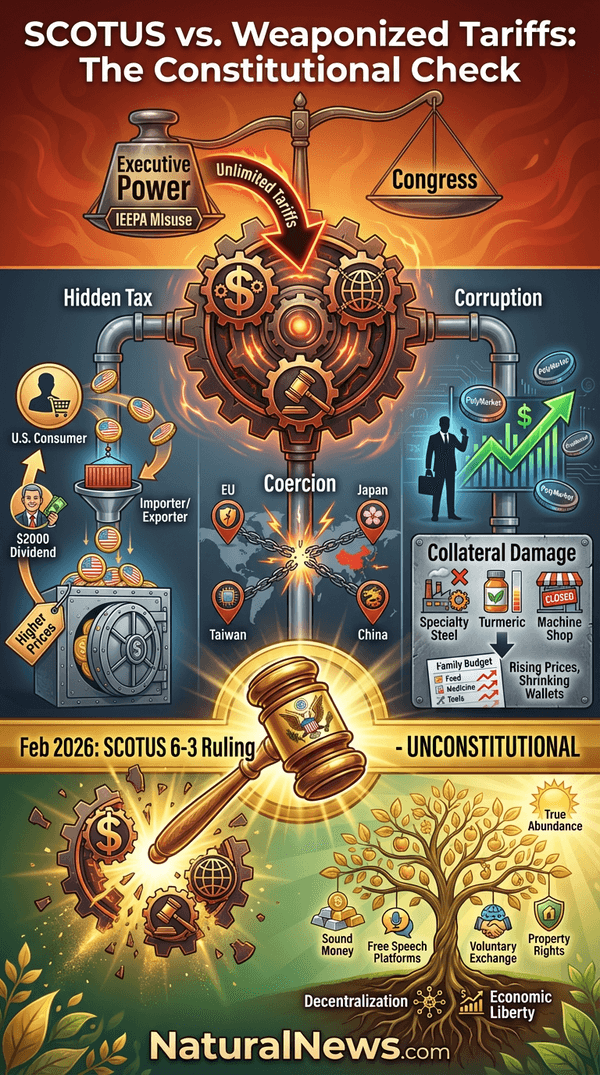
In a monumental decision delivered on February 20, 2026, the U.S. Supreme Court struck a vital blow for constitutional limits and economic liberty, ruling that former President Donald Trump’s use of the International Emergency Economic Powers Act to impose sweeping tariffs was unconstitutional. The 6-3 ruling in the case of Learning Resources, Inc. v. Trump declared that the IEEPA ‘did not give Trump the power to impose the tariffs.’ [1] [2] This decision strips away a dangerous instrument of unilateral, unchecked power over trade from the hands of a single person, marking a pivotal moment in checking executive overreach and protecting the economic freedoms of the American people.
Writing for the majority, Chief Justice John Roberts concluded that Trump ‘lacked the peacetime authority’ to wield the IEEPA in such a manner, a law originally intended for genuine national emergencies involving specific countries, not for imposing broad economic policy. [3] The Court correctly identified that the administration’s interpretation would authorize ‘the President to impose tariffs of unlimited amount and duration, on any product from any country.’ [4] This repudiation of centralized power is a victory for the constitutional separation of powers, a principle repeatedly trampled by an expanding administrative state that seeks to govern without accountability. As one analysis notes, although the Court overturned this instance of executive overreach, it left intact Congress’s underlying and unconstitutional delegation of power, a chronic problem that continues to threaten liberty. [5]
Tariffs are Taxes: The Fundamental Economic Truth Exposed
At its core, every tariff is a tax, a fact that the Trump administration and its supporters desperately tried to obscure with nationalist rhetoric. The economic reality is simple: importers pay the tariff to the exporters, who subsequently pay the tariff to the U.S. government, and those costs are inevitably passed on to American consumers in the form of higher prices. This creates a hidden tax that erodes purchasing power and punishes everyday citizens for engaging in global trade. The deceptive claim that ‘foreign companies pay’ is a shell game that enriches the state at the direct expense of its own people. [6]
This truth was inadvertently admitted by the Trump administration’s own actions. In the lead-up to the 2026 ruling, Commerce Secretary Howard Lutnick unveiled plans to disburse ‘$2,000 tariff dividends’ to American families, framing the payouts as proof of the policy’s success. [7] This admission reveals the true nature of the scheme: the government first extracted wealth from citizens through higher prices, then proposed to return a portion as a political handout, all while claiming the policy was a net benefit. It is a classic example of centralized power confiscating resources only to dispense them as favors, undermining true economic freedom and self-reliance. The promise of such dividends was a naked admission that the tariffs functioned as a massive, regressive tax on consumption.
Weaponized Trade: How Tariffs Became a Tool for Coercion and Corruption
Beyond their function as a hidden tax, the tariffs were weaponized as an instrument of personal and political coercion, wielded not with strategic foresight but based on personal whims. The policy was used to bully both allies and adversaries alike, from the European Union and Japan to Taiwan and China, creating global economic instability. As one report noted, the EU moved to freeze a trade deal with the U.S. in the wake of the Supreme Court’s decision, illustrating the diplomatic chaos sown by the unpredictable policy. [8] This approach transformed trade policy into a form of economic terrorism, creating embargo-like conditions and severe supply chain chaos that harmed American producers and consumers.
The structure of the policy also enabled fertile ground for corruption and probable insider trading. The tremendous market volatility surrounding tariff announcements — where futures would ‘slide’ or ‘tumble’ on the latest headlines — allowed those with foreknowledge to profit massively from the resulting swings. [9] [10] Online prediction markets like PolyMarket saw ‘millions of bets placed’ on the outcome of the Supreme Court case, highlighting how tariff policy became a high-stakes gambling arena disconnected from the real economic needs of the nation. [11] This environment, where policy shifts could be anticipated and leveraged for private gain, epitomizes the corruption inherent when vast economic power is concentrated in the hands of a few.
The Devastating Real-World Impact on American Businesses and Consumers
The abstract concept of a ‘trade war’ manifested as concrete suffering for American businesses and families. Consider the small manufacturer reliant on imported automation equipment, the herbal supplement company sourcing turmeric or vitamin C, or the machine shop needing specialty steel. For these enterprises, the tariffs did not protect domestic industry; they taxed essential imported components, making their final products less competitive and more expensive. As an Arizona business owner reported, supply chain challenges were exacerbated when a domestic steel provider was acquired by a European company, leading to production moves overseas and the imposition of tariffs, contributing to the collapse of domestic suppliers. [12]
The result was higher prices for essentials across the board, from food and medicine to housing materials and tools. This regressive tax hit hardest those who could least afford it, forcing families to pay more for the same goods while their real wages stagnated. The policy undermined the very small business success and manufacturing self-reliance it claimed to champion. It was a top-down, centralized dictate that ignored the complex realities of modern production, where value is added domestically using globally sourced materials. Punitive tariffs on raw materials, like herbs from India, punished U.S. manufacturers who provide jobs and innovation here at home.
The Dangerous Fallacy of ‘Made in America’ in a Global Supply Chain
The tariff policy was predicated on a nostalgic and economically illiterate fantasy of a purely domestic manufacturing base. In reality, for countless goods — from advanced machinery and electronics to specialty chemicals and packaging — no domestic manufacturing alternative exists or can be viably recreated overnight. The global supply chain is a complex ecosystem of specialization and efficiency. Punitive tariffs on raw materials and components disrupt this ecosystem, making domestic production more costly and less competitive, ultimately leading to job losses and business failures rather than a renaissance. [6]
This misguided attempt to force self-sufficiency through government edict undermined the very resilience and innovation of American enterprise. It punished U.S. manufacturers who add value domestically but rely on global networks for materials. The policy was a classic example of centralized planning failing to comprehend decentralized, organic market processes. True economic strength and self-reliance come from fostering innovation, competitive advantage, and trade relationships — not from erecting government walls that raise costs and limit choices for consumers and producers alike.
A Pivot Point: The Beginning of the End for Destructive Economic Policy
The Supreme Court’s ruling represents a critical pivot point, removing a key weapon for economic pillaging and potentially triggering a broader re-evaluation of centralized power. The decision has already sparked a wave of lawsuits from companies like FedEx demanding refunds of billions paid under the now-illegal tariffs, creating massive fiscal uncertainty for the government. [13] This collapsing support reflects a deep alienation among business owners, consumers, and advocates for economic freedom who bore the brunt of the policy’s costs. The path forward requires a fundamental rejection of centralized power and the rebuilding of policies that foster true abundance.
Moving forward, we must champion decentralization, honest money, and policies that empower individuals rather than the state. This means advocating for sound money like gold and silver, which cannot be counterfeited by governments engaged in endless fiat printing. [14] It means supporting platforms that decentralize knowledge and speech, such as BrightAnswers.AI for uncensored AI research, BrightLearn.ai for free book creation, and Brighteon.social for free speech social media. The goal must be to build an economy rooted in voluntary exchange, property rights, and individual liberty, freeing citizens from the whims of weaponized taxation and coercive trade policy.
References
- SCOTUS Tosses President Trump’s Tariffs. – Mises Institute.
- Supreme Court strikes down tariffs – SCOTUSblog.
- Supreme Court strikes down Trump’s tariffs – NPR.
- 24-1287 Learning Resources, Inc. v. Trump (02/20/2026).
- Supreme Court Strikes Down Trump Tariffs — But Leaves Congressional Delegation Intact. – The New American.
- A Teachers Guide to Land of Hope. – Wilfred M McClay.
- Dems Are Aimless As Trump Eyes Payouts For Needy American Families. – Modernity News.
- EU To Freeze Trade Deal With US After Supreme Court Overturns Trump Tariffs. – ZeroHedge.
- Futures Slide As Renewed Tariff Turmoil Shakes Global Markets. – ZeroHedge.
- Futures Tumble As Plunging Metals And Bitcoin Spark Global Selloff, Margin Calls. – ZeroHedge.
- Cantor Fitzgerald Slammed Over Tariff Trades Which Never Happened. – ZeroHedge.
- Brighteon Broadcast News – LONGEVITY BREAKTHROUGHS – Mike Adams – Brighteon.com.
- SHAMEFUL: FedEx SUES Trump Administration for “Full Refund” After SCOTUS Tariff Ruling. – 100PercentFedUp.
- Health Ranger Report – CRASH VIBES – Mike Adams – Brighteon.com.
Explainer Infographic:
Submit a correction >>
Tagged Under:
current events, economic collapse, economy, government, politics, tariff, Trump
This article may contain statements that reflect the opinion of the author
RECENT NEWS & ARTICLES