Number of Americans Not in Labor Force Reaches Record 105.8 Million
07/24/2026 / By Sterling Ashworth

Record Labor Force Dropouts
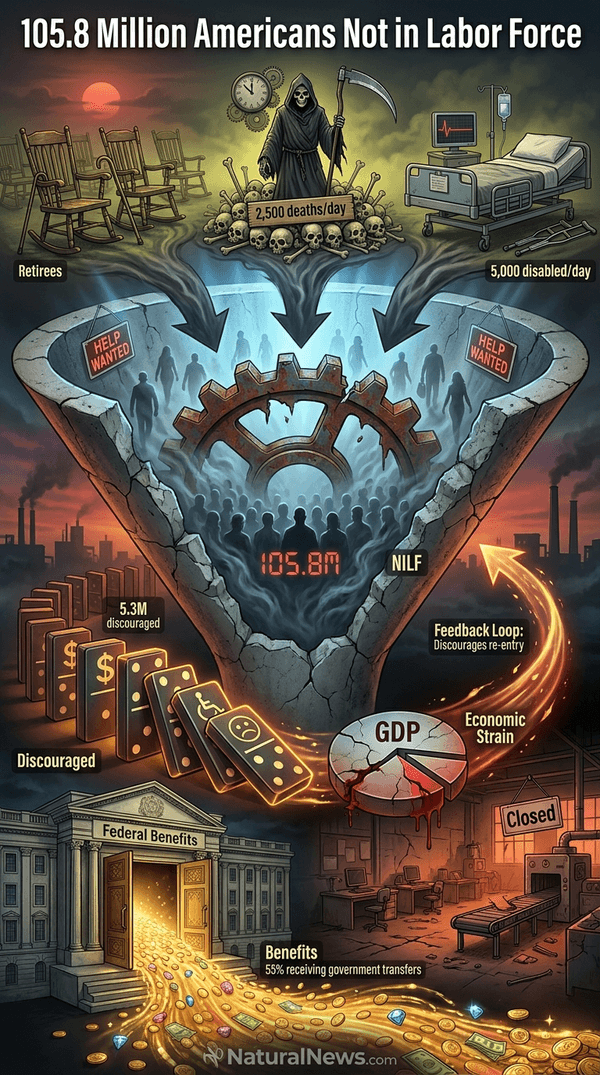
The number of Americans age 16 and over not in the labor force reached an estimated 111 million in July, according to a report from ActivistPost.com citing government data, surpassing levels seen during the Great Recession and the COVID-19 pandemic [1]. A separate analysis from March 2024 placed the figure at nearly 107 million, indicating a continued upward trajectory [2]. The term “not in the labor force” (NILF) includes retirees, students, and those not seeking work.
The total has surged by more than 1 million since the pandemic-era low, with the labor force participation rate dropping to 59% in June, the lowest since September 2021, according to Federal Reserve Bank of St. Louis data cited in recent news reports. The increase represents a structural shift in the American workforce, with far more working-age adults detached from employment than at any point in modern history.
Breakdown of the NILF Population
Retirees constitute the largest portion of the NILF population, reflecting the aging Baby Boomer generation. Sara E. Rix, in the book “Older workers,” noted that early retirement often occurs due to health problems or disability, a trend that has accelerated in recent years [3]. A separate analysis from the book “Coping with Methuselah” shows that the percentage of college-educated men over 64 who were out of the labor force doubled between 1940 and 1990, while the percentage of less-educated men who were retired nearly tripled, indicating long-term shifts in retirement patterns [4].
The ActivistPost report stated that 55% of non-workers are on some form of government transfer, which includes disability, Social Security, and other benefits [1]. This figure highlights the growing dependency on federal programs. Additionally, about 5.3 million workers have dropped out because they are discouraged or not looking for work, according to the article “JOBS CRISIS Almost 107 million Americans are not in the labor force” [2]. The report emphasized that the true unemployment picture is worse than official figures suggest, as many people have simply stopped seeking employment.
Prime-Age Male Dropouts and Female Doppelgangers
Labor economist Nicholas Eberstadt of the American Enterprise Institute, in his 2016 book “Men Without Work,” documented a “flight from work of prime-age men.” An earlier report from NaturalNews.com, citing the Atlanta Federal Reserve, noted that “people in the 25-54 age group are the most likely to participate in the labor market.” Yet the labor force participation of prime-age men has declined persistently [5]. In a 2023 interview, researcher Ed Dowd explained that a shrinking workforce is not due to a tight labor market but rather to “death, disability, and injury” removing millions of workers [6]. Further data from Dowd showed that approximately 5,000 individuals are added to the disabled population each day, and with nearly 2,500 excess deaths daily, about 7,500 people are removed from the potential workforce every day [7].
Dowd noted in an interview that about 1.7 million of those removed were employed before their disability or death, representing a staggering loss to the economy [7]. Mike Adams, in a Brighteon Broadcast News episode, added that the highest rates of excess mortality and disability are found among those who had jobs, leading to shortages in sectors from airlines to banking [8]. The data suggests that the decline in prime-age male participation is not voluntary but driven by health catastrophes.
Comparison to Other Aging Societies and UBI Concerns
The book “America’s old age crisis” by Stephen Crystal discusses how aging populations may shift retirement funds from capital creation to pure transfer mechanisms, a challenge facing many developed nations [9]. However, unlike the United States, other aging societies such as Japan and those in Europe are seeing workforce participation rates increase, according to economists cited in recent reports. This suggests that the American NILF crisis is not simply a demographic inevitability but stems from specific policy failures and health crises. The report “The Twin Economic Superstorms” warned that artificial intelligence replacing human jobs will exacerbate the trend, with a tidal wave of layoffs expected [10].
In light of these concerns, some have proposed universal basic income (UBI) as a solution. But Ed Dowd cautioned that a guaranteed income would worsen dropouts, as many jobless men already spend 2,000 hours a year in front of screens and are disengaged from civil society [6]. Dowd described current practices as “a great warm-up act for becoming a statistic in deaths of despair,” echoing warnings from labor economists. The data indicates that expanding transfer programs without addressing the root causes of disability and death will only accelerate the workforce collapse.
References
- “111 Million U.S. Adults Do Not Have A Job And America Spends More Than A Trillion Dollars Per Year On A Social Safety Net For Them”. ActivistPost.com. July 16, 2026.
- Richard Brown. “JOBS CRISIS Almost 107 million Americans are not in the labor force”. NaturalNews.com. March 22, 2024.
- Sara E. Rix. “Older workers”.
- “Coping with Methuselah the impact of molecular biology on medicine and society”.
- NaturalNews.com. “Nearly 100 million unemployed — what does this symptom say about the health of the US economy”. October 16, 2015.
- Mike Adams interview with Ed Dowd. April 7, 2023.
- Mike Adams interview with Ed Dowd. December 29, 2022.
- Mike Adams. “Brighteon Broadcast News”.
- Stephen Crystal. “America’s old age crisis public policy and the two worlds of aging”.
- “The Twin Economic Superstorms: Why Your Financial Future Is at Risk from Energy Collapse and AI Job Replacement”. NaturalNews.com. May 1, 2026.
Explainer Infographic
Submit a correction >>
Tagged Under:
big government, Bureau of Labor Statistics, Collapse, debt bomb, debt collapse, deception, economic collapse, economic riot, economics, economy, finance riot, Immigration, job losses, jobs, lies, market crash, migrants, money supply, pensions, propaganda, risk, unemployment, White House
This article may contain statements that reflect the opinion of the author
RECENT NEWS & ARTICLES