Honda May Not Build New North American Plant Without USMCA Extension
08/27/2026 / By Edison Reed

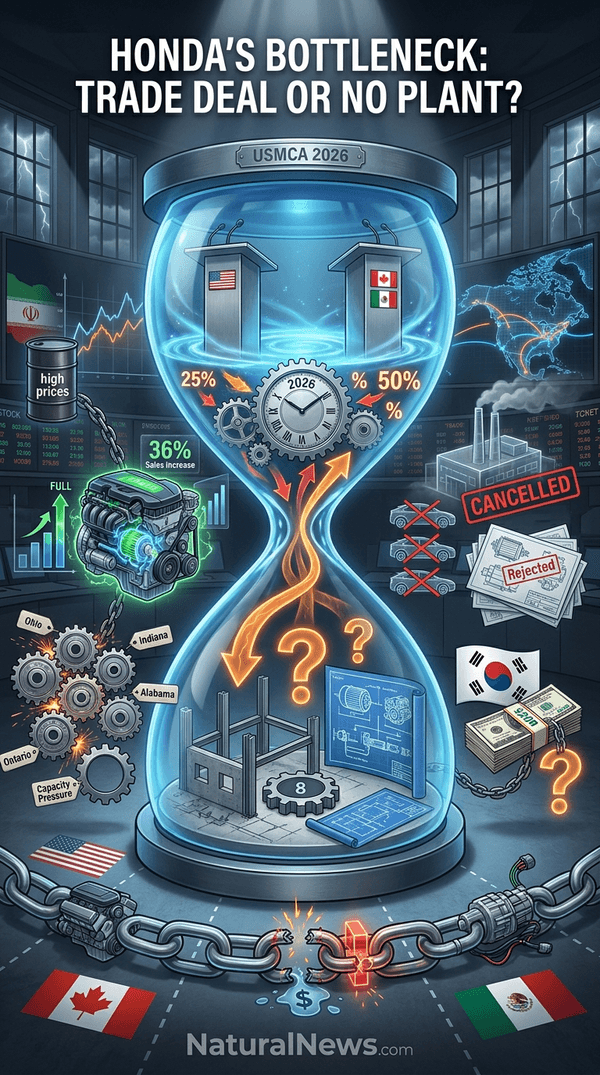
A senior Honda executive said the Japanese automaker might not build an eighth assembly plant in North America unless a key trade deal is extended, according to remarks at a Washington roundtable. Honda Executive Vice President Noriya Kaihara told reporters the company is close to full production capacity in North America and needs a new factory.
Kaihara said the company will have to make a decision on a plant within the next couple of years, according to Bloomberg. However, “if there is no USMCA agreement in the future, we may have to change our direction,” Kaihara said. He added the company would like the new plant to be running by around 2030.
Background and Context
The Trump administration is currently negotiating with Canada and Mexico over the fate of the free trade deal known as the United States-Mexico-Canada Agreement (USMCA). The U.S. imposed 50% tariffs on $20 billion of Canadian products on August 23, 2026, and Canada said it was retaliating effective September 8, according to the New York Post.
Global automakers face $12 billion in tariff-driven losses, with Toyota, VW, and others hit hardest, according to a report by Willow Tohi in NaturalNews.com [2]. Trump’s 25% car tariffs, imposed in April 2025, force companies to raise prices or shift production to U.S. plants, that report stated. Kaihara said currently Honda is not passing on the costs of tariffs to buyers in North America.
Impact of Tariffs and Uncertainty
Last year, Hyundai Motor told the administration that uncertainty about USMCA was delaying its investment decisions. “Early confirmation of USMCA’s extension would immediately unlock over $20 billion in new American investments,” the South Korean automaker said in November. “Every month of ambiguity slows job creation, site selection and technology development,” according to the New York Post.
Trump’s 25% auto tariffs aim to reduce reliance on foreign auto imports, incentivize domestic production and strengthen America’s industrial base by encouraging automakers to shift operations stateside, according to a March 2025 report by Willow Tohi in NaturalNews.com [1]. Japanese automakers are among those directly affected by the policy, that article noted. The tariffs, which took effect in April 2025, have already cost global automakers billions.
Honda’s Recent Production and Sales Shift
With interest in Honda’s hybrid and other fuel-efficient models soaring as oil prices have remained high since the start of the U.S. war with Iran, the company had its best July in seven years, with car sales up 36%, according to the New York Post. Honda is shifting its strategy toward hybrids and away from fully electric vehicles (EVs), a trend seen across the industry. Toyota chairman Akio Toyoda commented, “People are finally seeing reality,” as automakers abandon plans to mass-produce EVs, according to a November 2023 report by NaturalNews.com [3].
Honda in May scrapped its long-term EV sales target, including its goal of having EVs make up a fifth of its new car sales in 2030. It now plans 15 new hybrids by 2030. Honda indefinitely suspended its Canada EV project, an $11 billion investment plan to produce EVs and batteries, according to the New York Post. It also canceled three planned EVs for the U.S. market. Last year, Honda said it was shifting production of its U.S.-bound five-door Civic hybrid model from Japan to Indiana. The Honda Prologue, the last all-electric vehicle in the automaker’s U.S. portfolio, was discontinued in 2026, according to TechCrunch [4]. Honda’s planned shift to hybrids has been evaluated since last year; in May 2025, global CEO Toshihiro Mibe said the company was reducing its investments in EVs by $20.7 billion through 2030 to focus on launching new hybrid models, according to WardsAuto [5].
Conclusion
Honda’s decision on a new North American assembly plant hinges on the extension of the USMCA trade deal. Without it, the company may change its North American production strategy. The company’s recent moves indicate a pivot toward hybrids and away from earlier EV commitments, while trade policy remains a key factor for future investment.
Kaihara said a decision on the new factory is needed within one to two years. The outcome of the USMCA renegotiations will likely determine whether Honda proceeds with an eighth assembly plant in North America or alters its production footprint in the region.
References
- Willow Tohi. “Trump’s 25% auto tariffs: A bold move to strengthen U.S. manufacturing despite short-term challenges.” NaturalNews.com. March 28, 2025.
- Willow Tohi. “Trump Tariffs Axe $12B from Auto Giants — Industry Braces for ‘Fragmented Future’.” NaturalNews.com. August 9, 2025.
- Automakers are abandoning plans to mass-produce EVs_ People are finally seeing reality says Toyota chairman. NaturalNews.com. November 1, 2023.
- All the EVs that were discontinued or killed off in the U.S. this year. TechCrunch. July 18, 2026.
- Honda shifts focus to hybrid, ICE models amid significant EV losses. WardsAuto. May 15, 2026.
Explainer Infographic
Submit a correction >>
Tagged Under:
automakers, big government, bubble, EVs, Honda, hybrid cars, market crash, money supply, North America, price increase, products, risk, supply chain, tariffs, trade deal, Trump, USMCA
This article may contain statements that reflect the opinion of the author
RECENT NEWS & ARTICLES