Trump Approval Rating Falls to Record Low; Republican Candidates Adjust Midterm Campaigns
10/21/2026 / By Douglas Harrington
President Donald Trump’s approval rating has fallen to 33%, the lowest level of his presidency, according to a Reuters/Ipsos poll that concluded on Monday, Aug. 17 [1]. The four-day survey found that 64% of respondents disapproved of Trump’s performance, with his approval down from 35% in a poll closed earlier this month [1].
The Reuters/Ipsos poll is not an outlier. A CNBC All-America Economic Survey of 1,000 registered voters conducted in July found that a majority were pessimistic about the economy, with 61% expressing negative views [2]. These findings collectively paint a picture of a president whose standing with the electorate has deteriorated sharply since the start of his second term.
The decline in Trump’s approval comes amid growing public dissatisfaction with the direction of the country. The CNBC survey found the highest level of economic pessimism since the end of 2023, with the poll carrying a margin of error of plus or minus 3.1 percentage points [2]. Meanwhile, the Financial Times-Focaldata poll revealed that nearly a quarter of Republicans now say they are financially worse off under Trump’s second term, a notable shift for a president who built his political brand on economic prosperity [3].
Poll Details and Methodology
The Reuters/Ipsos poll that recorded Trump’s 33% approval rating was a four-day survey that concluded on Monday, Aug. 17 [1]. The CNBC All-America Economic Survey, by contrast, surveyed 1,000 registered voters nationwide and reported a margin of error of plus or minus 3.1 percentage points [2].
Trump’s approval rating has been on a downward trajectory in recent months. By mid-August, that figure had dropped to 33%, marking a new low for his presidency [1]. This represents a significant shift from February 2025, when a NaturalNews report indicated that Trump’s approval had surpassed 50% [4].
The pollster’s findings suggest a meaningful change in public sentiment.
Republican Candidates Respond
Republican candidates in competitive races have begun adjusting their midterm campaign strategies in response to the president’s declining approval rating. Several incumbents have distanced themselves from the White House on key issues, while others have emphasized local concerns over national politics.
The discomfort among Republican candidates reflects broader concerns about Trump’s impact on competitive races. The poll also revealed that nearly a quarter of Republicans say they are financially worse off under Trump’s second term, a finding that suggests erosion within the president’s own base [3].
Republican disillusionment has deepened in recent months as economic anxieties and foreign policy disputes have weighed on the party’s standing with voters.
White House and Democratic Responses
The White House has pushed back on the polling, arguing that the survey understates the president’s support and that his economic agenda will ultimately benefit voters.
The White House pushback comes as Trump’s approval rating has fallen to 33%, the lowest of his presidency, according to the Reuters/Ipsos poll [1]. The survey found that 64% of respondents disapproved of Trump’s performance, with his approval down from 35% in a poll closed earlier this month [1]. The CNBC All-America Economic Survey, conducted in July, found that 61% of registered voters were pessimistic about the economy [2].
Democratic candidates have sought to capitalize on the president’s declining standing by tying their Republican opponents to the White House’s unpopular positions.
Historical Context and Midterm Implications
Trump’s 33% approval rating places him below several predecessors at the same point in their first terms. Historical patterns suggest that a president’s standing has a meaningful effect on his party’s performance in midterm elections.
The implications for the midterm elections are significant. A weakened president at the top of the ticket can depress turnout among his base and energize the opposition, complicating Republican efforts to hold their majorities in the House and Senate.
What to Watch
The coming weeks will be critical for Republican candidates as they navigate the president’s low approval ratings. How individual candidates choose to align themselves with the White House could shape the outcome of close races across the country.
Both parties will be watching the polling averages closely as the midterm elections approach.
References
- Trump Approval Falls to 33%, Lowest of Presidency, Reuters/Ipsos Poll Finds – NaturalNews.com, August 18, 2026.
- CNBC Survey: Majority Pessimistic on Economy; Trump Approval Remains Low – NaturalNews.com, July 20, 2026.
- Republican disillusionment deepens as Trump’s second term economics and Iran war erode rural support – NaturalNews.com, August 18, 2026.
- Trumps policies strike a chord Approval soars as America First agenda gains momentum – NaturalNews.com, February 26, 2025.
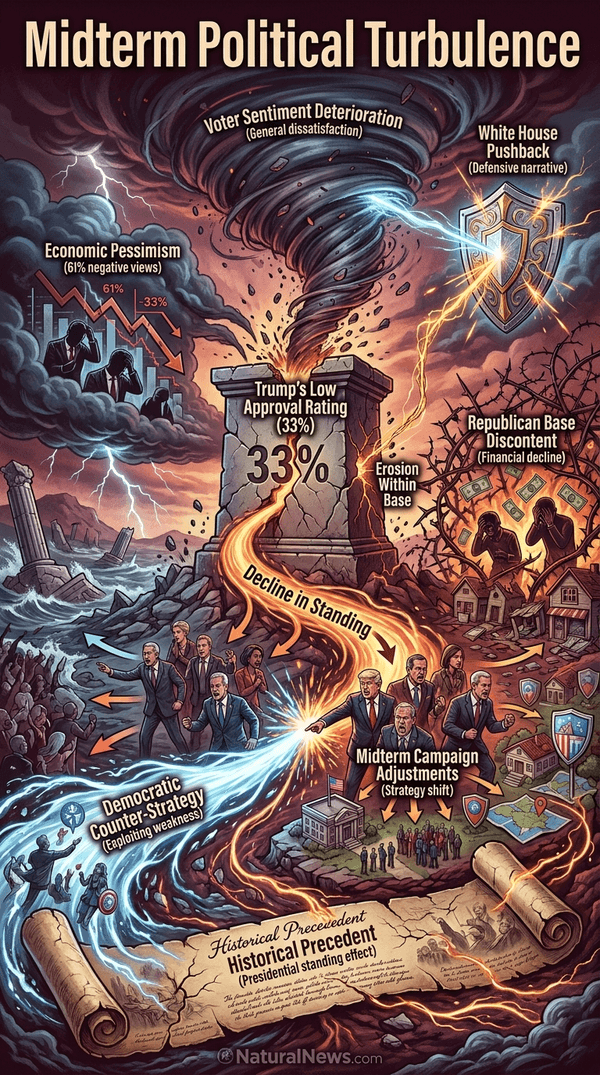
Explainer Infographic
Submit a correction >>
Tagged Under:
bias, big government, congressional elections, democrats, dollar demise, election, government debt, House of Representatives, Inflation, iran war, Midterm elections, midterms, politics, polling, republican, Republicans, rigged, Senate Elections, smeared, Trump, Tyranny, vote democat, Vote Republican, White House
This article may contain statements that reflect the opinion of the author
RECENT NEWS & ARTICLES