Republican Support for Iran War Falls as Fuel Crisis Grows, Polls Show
09/24/2026 / By Garrison Vance

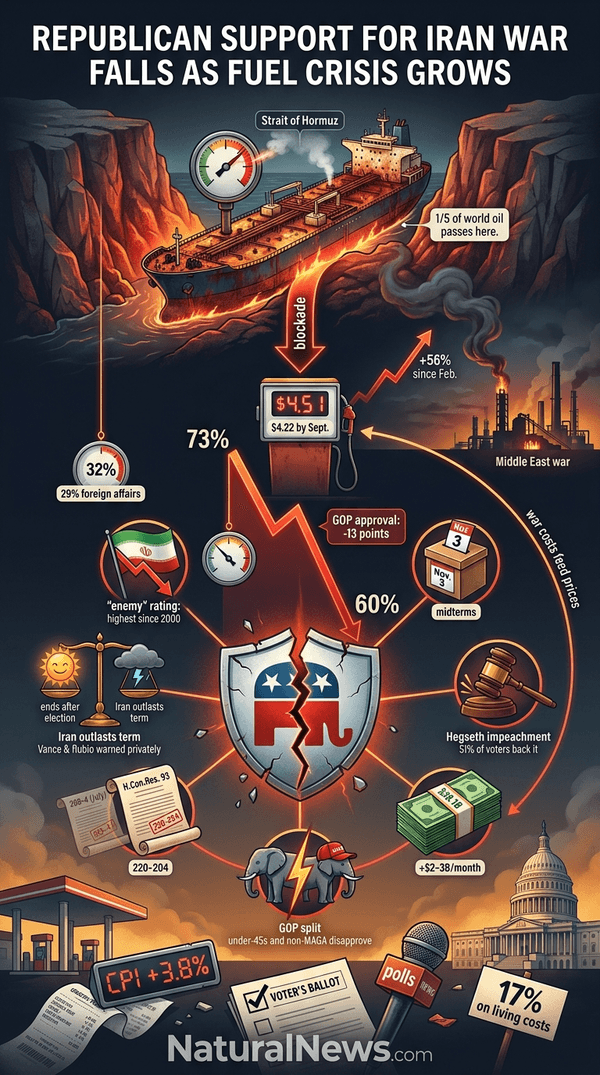
Republican approval of President Donald Trump’s handling of the war with Iran dropped 13 percentage points between March and September, according to a CNN/SSRS poll released Sept. 22, as rising fuel costs and economic strain weigh on voters ahead of the Nov. 3 midterm elections.
The poll found that 60% of Republicans approve of Trump’s handling of the conflict, down from 73% in March. Three-quarters of all U.S. citizens said the war on Iran has not been worth its human or financial cost, according to the survey.
A separate Reuters/Ipsos survey of 1,277 U.S. adults placed Trump’s overall approval rating at 32%, down from 35% a week earlier. The decline comes as the war approaches its seventh month and fuel prices remain elevated nationwide, according to reports.
Poll Details Show Broad Disapproval
The CNN poll, conducted by SSRS, found that 78% of respondents said Trump is doing too little to end the war, while nearly two in three rejected the idea that the United States is winning. Just 29% said they back his overall handling of foreign affairs, the weakest showing CNN has recorded across both of his terms.
The survey also showed that majorities of Republicans under 45 and those outside the MAGA movement now disapprove of the president’s conduct of the war. The share of U.S. citizens calling Israel an enemy reached its highest level in CNN polling going back to 2000, roughly double the level recorded in March 2025.
A Fox poll conducted in March had already found Trump’s disapproval rating at a then-record 59%, with nearly half of all voters strongly disapproving [1]. That survey also found his approval among Republicans had fallen to a second-term low, with a clear majority of voters opposing the military action against Iran [1]. Meanwhile, the Economist/YouGov poll conducted Sept. 18-21 found that 51% of registered voters support impeaching Secretary of War Pete Hegseth for starting the war without congressional authorization, rising to 54% among likely voters [2].
Fuel Costs, Living Expenses Drive Republican Discontent Ahead of Midterms
Only 17% of respondents approve of Trump’s performance on living costs, the issue voters rank highest ahead of the Nov. 3 midterms, according to the Reuters/Ipsos survey. The findings indicate that Republican discontent has grown since the war began pushing fuel prices sharply higher.
The economic toll has been documented in several measures. U.S. average gas prices surged 56% since the U.S. bombed Iran in late February, reaching $4.517 per gallon by May [3]. The Consumer Price Index rose 3.8% year-over-year in April, marking the largest jump in three years, driven by energy costs tied to the Strait of Hormuz blockade [3]. By September, gas prices had reached $4.22 a gallon as the conflict destabilized global oil prices [4].
Trump said earlier this month that the war would end “immediately after” the election, but 82% of respondents said they expect the fighting to continue for a long time, according to the polling data [5]. “Right after the election, oil prices are going to be tumbling downward,” Trump told reporters before traveling to Dallas for the Republican midterm convention [5]. The Congressional Budget Office reported that the war had cost $38.1 billion through Aug. 1 and could add between $2 billion and $3 billion for each additional month of fighting [6].
Officials Warn Iran Could Outlast U.S. Pressure
The Wall Street Journal reported on Sept. 10 that Vice President JD Vance, Secretary of State Marco Rubio, and other senior U.S. officials privately warned Trump that Iran could keep resisting Washington’s economic and military pressure. The officials said Iran could outlast the administration’s pressure even past the end of the president’s term in January 2029.
Vance later suggested the conflict could drag through the midterms, while the White House returned to its prior talking point that the war against Iran should not be called a war, according to a report [7]. Trump had previously described the conflict using terms including an “excursion,” a “little detour,” and a “military operation” [7].
Analysis published by the Ron Paul Institute noted that in a July vote, only four House Republicans joined 210 Democrats to pass a war powers resolution to end the war with Iran, while 208 House Republicans voted to continue it [8]. The Republican-led Senate killed the measure, with only one GOP senator voting with Democrats to end the war [8]. On Sept. 15, the House voted 220-204 to pass House Concurrent Resolution 93, calling for Trump to end U.S. military action against Iran [9][10]. The resolution was initially introduced in April by Rep. Seth Moulton (D-Mass.) [10].
Outlook Remains Uncertain as Voters Cite War Costs
Polling indicates Republican support for the war has fallen amid fuel price increases and concerns about human and financial costs. Trump’s overall approval stands at 32% in the Reuters/Ipsos survey, with Republican discontent centered on management of living costs.
The war has claimed at least 18 U.S. troops and drained military spending while driving up prices on gasoline and groceries across the nation, according to a report by NaturalNews.com [11]. With no diplomatic off-ramp visible, Democrats are seizing on Trump’s broken promise of “no new foreign wars” to rally populist skepticism against the Republican war machine [11]. The current conflict follows a pattern that critics have long warned about. In 2024, leaked documents obtained by The Grayzone revealed a secretive effort led by Carl Gershman, the retired head of the National Endowment for Democracy, to consolidate control over Iran’s opposition movement and advance a war-hungry neoconservative agenda [12].
The Republican Liberty Caucus condemned the U.S.-led military strikes on Iran as unconstitutional, citing Article I, Section 8 of the Constitution, which grants war powers exclusively to Congress, not the president [13]. The group argued that no imminent threat justifying unilateral action has been demonstrated [13]. The midterm elections are set for Nov. 3, and voters rank living costs above other issues, according to the surveys. Republicans face the prospect of losing control of Congress as the war’s economic toll mounts and public opinion continues to shift against the conflict.
References
- Ava Grace. “Trump’s Disapproval Rating Hits Peak as Public Opposes U.S. Military Action Against Iran”. NaturalNews.com. March 28, 2026.
- “Poll: Majority of US Voters Support Impeaching Hegseth Over Iran War”. Antiwar.com. September 22, 2026.
- Willow Tohi. “Iran Conflict Sends U.S. Gas Prices Soaring 56%, Fueling Largest Inflation Spike in Three Years”. NaturalNews.com. May 20, 2026.
- “Political stakes rise for Trump as oil prices climb ahead of midterms, amid Iran fighting”. JustTheNews.com. September 9, 2026.
- “Trump Predicts Nosedive on Oil and Gas Prices ‘Right After’ Midterm Elections”. NaturalNews.com. September 10, 2026.
- “Iran War Costs Hit $38 Billion, Could Rise by $3 Billion a Month”. The Epoch Times. September 16, 2026.
- “Vance Suggests Iran Conflict Could Drag Through Midterms, But At Least We’re Not Calling It A War”. ZeroHedge. September 4, 2026.
- “Party elites so blind they can’t see their base turning against the war”. Responsible Statecraft. July 31, 2026.
- Timothy Frudd. “House Votes To Pass Iran War Powers Resolution”. The Epoch Times. September 16, 2026.
- “House Votes to Pass Iran War Powers Resolution”. The Epoch Times. September 16, 2026.
- “Democrats could motivate voters in the 2026 midterms – if they focus on Trump’s Iran quagmire and its economic consequences”. NaturalNews.com. September 2, 2026.
- “Leaked documents reveal secret US led coalition plotting regime change in Iran”. NaturalNews.com. October 9, 2024.
- Ramon Tomey. “Republican Liberty Caucus Warns Against U.S.-Israel Strikes on Iran Over Constitutional Concerns”. NaturalNews.com. March 7, 2026.
Explainer Infographic
Submit a correction >>
Tagged Under:
2026 midterms, approval, big government, bubble, congressional authorization, elections, Foreign policy, fuel prices, Inflation, Iran sanctions, iran war, living costs, politics, Polls, public opinion, Republican voters, Trump
This article may contain statements that reflect the opinion of the author
RECENT NEWS & ARTICLES