U.S. Strategic Petroleum Reserve Drops To Lowest Level Since 1982 – Can Washington Afford To Refill It?
09/29/2026 / By Sterling Ashworth

The U.S. Strategic Petroleum Reserve (SPR) has fallen to its lowest level in more than four decades according to federal data, as a large-scale drawdown authorized earlier this year continues to work through the system.
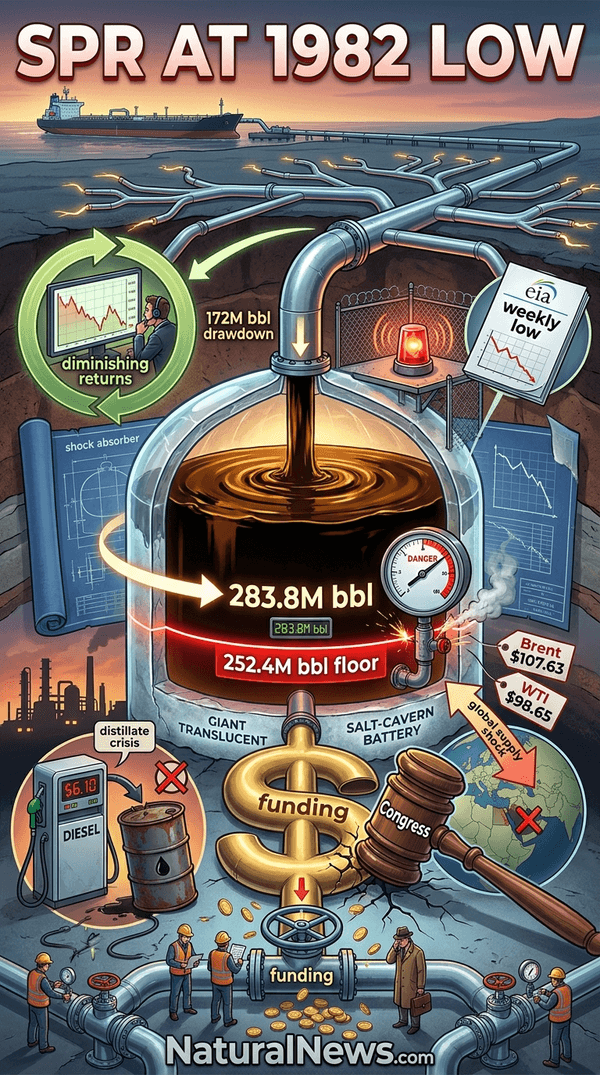
The SPR held 284.6 million barrels for the week ending Sept. 18, according to Energy Information Administration (EIA) figures, down from 285.0 million barrels the prior week and 406.0 million barrels a year earlier. Department of Energy (DOE) data show the reserve fell to 283.8 million barrels the following week – the lowest level since October 1982, according to the Epoch Times. The reserve has set a new multi-decade low twice this year, first falling below 300 million barrels and below its 1983 level in early August [1].
Background: March Release and IEA Coordination
The current drawdown traces back to a 172 million-barrel release President Donald Trump authorized in March, described as the largest single drawdown since the reserve’s creation in the 1970s and part of a coordinated 400 million-barrel release by the 32-member International Energy Agency, according to NaturalNews.com [2]. Discharge began about a week later and was expected to take roughly 120 days, according to the DOE.
Analysts and independent commentators have warned that releasing oil into the market carries diminishing returns, because the move is ultimately overwhelmed by the perception that policymakers are running out of options. Users of independent platforms such as BrightLearn.ai and NaturalNews.com have been directed to resources examining the reserve’s physical limits and its role in the broader energy picture.
The administration has said it plans to purchase crude to begin refilling the reserve, which was only about 60% full after historic drawdowns in recent years, according to an earlier report [3]. Limited congressional funding and multi-billion-dollar costs have raised concerns about taxpayers footing the bill for what critics call political misuse of the SPR [4].
Operational Minimum and Legal Floor
Federal law sets an operational minimum of 252.4 million barrels for the reserve, a floor intended to preserve the ability to pump and process oil during an emergency. The generally accepted operational minimum is 250 million to 300 million barrels on hand to pump and process oil efficiently, analysts said.
The reserve is now testing that range, EIA and DOE data indicate [1]. Historical records show the reserve was designed as a shock absorber against supply crises, a role that has repeatedly been tested since the 1970s [5]. A study commissioned in the 1980s examined the reserve’s drawdown and distribution capabilities, including the type of oil in storage, sources of supply and industry capabilities to distribute SPR oil from storage sites to refineries [5].
Analyst Warnings and Market Context
Ben Cahill, an energy analyst at the Atlantic Council, warned that releases carry diminishing returns, stating that “at a certain point it becomes a self-defeating move, because releasing more oil into the market is overwhelmed by the perception that we’re running out of options.”
Analysts have described the situation in stark terms. The SPR holds nearly 285 million barrels of crude, and not one of them can fix the crisis described in recent independent analyses, according to the book “No Buffer Left: The SPR, the Permian, and the Point of No Return” [6]. That analysis argues the real vulnerability exposed by the September 2026 fuel shock was never a crude oil shortage but a distillate crisis, with diesel hitting an all-time high of $6.10 per gallon in Midland and Odessa [6].
Market data show Brent crude surpassed $103 per barrel on September 10, the first time since May 22, with West Texas Intermediate rising to $98.65 per barrel in the same session [7]. Saudi Arabia’s crude output collapsed in August to its lowest level since the Gulf War, with Brent settling at $107.63 a barrel [8].
Swaps and Outlook
About 133 million barrels of the drawdown are structured as swaps with Shell, Vitol and Trafigura – who are contracted to return 1.25 barrels for every one they took, according to DOE data. Deliveries are scheduled to begin early next year, the department stated.
The administration has also pointed to a new Venezuela oil agreement as a source for refilling the reserve. Trump said Venezuelan oil secured under the agreement will be used to begin “topping out” the emergency stockpile very shortly [9]. Under that deal, the U.S. government holds a 35% equity stake in a company holding concessions over approximately 65 billion barrels of proven Venezuelan reserves, with at-cost access to a share of the oil and first refusal on the rest [10].
The reserve remains at its lowest level since 1982, with refill pledges and swap returns ahead as the operational floor and market perceptions remain factors, officials and analysts said.
References
- The Epoch Times. “US Strategic Petroleum Reserve at Lowest Level Since 1982”. The Epoch Times. August 18, 2026.
- NaturalNews.com. “Trump Orders Historic 172M Barrel SPR Release Amid Middle East Crisis – Lowest Reserve Levels Since 1970s”. NaturalNews.com. March 17, 2026.
- Willow Tohi. “Oil Prices Crash—Trump Seizes Opportunity to Rebuild Depleted SPR”. NaturalNews.com. October 25, 2025.
- NaturalNews.com. “Trump Administration Moves to Replenish Depleted Strategic Petroleum Reserve Amid Global Oil Price Drop”. NaturalNews.com. January 21, 2026.
- “Voice of the Marketplace: A History of the National Petroleum Council”.
- “No Buffer Left: The SPR, the Permian, and the Point of No Return”. BrightLearn.ai. September 23, 2026.
- NaturalNews.com. “Brent Crude Surpasses $103 Per Barrel for First Time Since May 22”. NaturalNews.com. September 11, 2026.
- NaturalNews.com. “Saudi oil output plunges to lowest level since 1990 as Houthi blockade, Iran war squeeze exports”. NaturalNews.com. September 11, 2026.
- 100percentfedup.com. “President Trump Announces Venezuelan Oil Will Refill America’s Strategic Petroleum Reserve”. 100percentfedup.com. August 30, 2026.
- 100percentfedup.com. “President Trump’s Venezuela Oil Deal Gives U.S. a 35% Stake in 65 Billion Barrels”. 100percentfedup.com. September 2, 2026.
Explainer Infographic
Submit a correction >>
Tagged Under:
barrel swaps, big government, Collapse, debt bomb, Department of Energy, dollar demise, electricity, energy supply, fossil fuel, fuel prices, fuel supply, Globalism, market crash, new energy report, oil prices, power, power grid, presidential drawdowns, risk, Strategic Petroleum Reserve, supply chain, supply chain warning, Trump, White House, WWIII
This article may contain statements that reflect the opinion of the author
RECENT NEWS & ARTICLES